
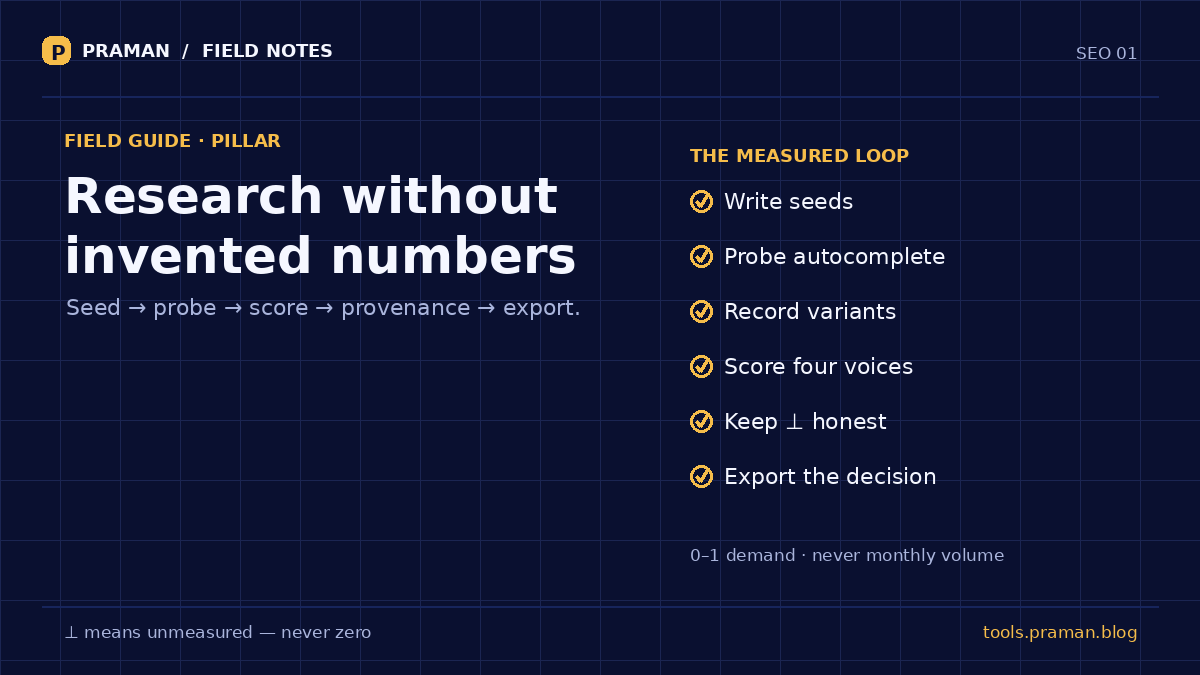
Most keyword research begins with a number: a monthly volume copied from a dashboard, multiplied by a difficulty score, sorted into a spreadsheet. The number feels like evidence because it has decimal places. It is not evidence; it is the output of somebody else’s model. If you cannot say where a number came from, how it was measured and what was left unmeasured, you cannot defend the decision it produced. There is a quieter way to do the work. Observe the language people actually type, record the observation, score it on a fixed scale, and carry the provenance into the export.
Key takeaways
- Demand is a 0–1 score, not a monthly volume. A deterministic score ranks evidence; it does not forecast searches.
- Four pinned voices keep one number from flattening the signal: breadth 50%, coverage 25%, density 15%, depth 10%.
- Unmeasured means ⊥, never zero. Missing signals are not silently renormalised into a confident-looking result.
- Provenance travels with every row: seed, variant, rank, voices, mode and timestamp.
- Live, Demo and Replay are different modes. Demo is free but always labelled sample data; Live is observed autocomplete; Replay reads recorded JSON.
Why the usual number-first workflow fails
The number-first workflow looks rigorous because it produces a sorted list quickly. Its weakness is upstream of the sorting. A monthly volume is a modelled estimate of private behaviour; a difficulty score is a modelled estimate of competition; a click-through curve is a modelled estimate of attention. None of these are things a research tool watched happen. When three modelled values are multiplied together, the result acquires an air of authority while remaining three steps away from any observation.
Such numbers may be useful elsewhere; they are unsuitable as the foundation of a method you must defend. We have written separately about why keyword volume is a guess and difficulty scores without a method. The starting point here is stricter: if a signal was not observed, do not convert it into a decimal.
There is a second failure mode. Tools that flatten diverse queries into a single score erase the shape of the evidence. A variant seen across many independent seeds and a variant seen once in one narrow probe can end up side by side. That is why the four voices matter more than any single headline value.
What can actually be observed
Praman measures public Google autocomplete signals server-side. The user supplies seeds; the app does the probing, so no API key is required. What comes back is language in rank order: a variant string, its position, the seed that produced it, and the time of the probe. Stack several seeds and you can also observe recurrence — the same variant appearing under different starting points.
What does not come back is a search count, a competition index, a revenue figure or a user’s intent in any mind-reading sense. Autocomplete is a language surface, not a telemetry feed. Treating it as telemetry is the original sin of keyword tooling. Treating it as a reproducible corpus of observed phrasing is what makes it useful. The boundary is documented on the methodology page.
The measured 6-step workflow
- Write seeds. Start with three to five phrases that describe the topic in your own words, not with a wishlist of ranking terms.
- Probe. Run each seed in Live mode, or use Replay to repeat a recorded run exactly. Demo mode is fine for learning the interface, but its data is sample data and must be labelled as such.
- Record variants. Keep the observed string, its rank and its seed. Do not paraphrase; the exact wording is the evidence.
- Read the voices. Note how recurrence, coverage, clustering and rank depth contribute to each row’s score.
- Mark ⊥. Any voice or signal you could not measure stays ⊥. Do not substitute zero and do not rebuild the score as if the missing value were empty.
- Export. Save the run as Markdown, CSV, JSON or HTML so the decision can be reviewed later with its provenance intact.
Notice what is absent: no step asks you to estimate traffic, no step asks you to borrow a competitor’s score, and no step lets an unmeasured field quietly vanish.
Worked example: three seeds
The rows below come from live Praman autocomplete probes run in India in November 2026. They are observations, not volume estimates. The scores shown are the recorded 0–1 demand scores from those runs.
| Seed | Observed variant | Rank | Recorded score | What it tells you |
|---|---|---|---|---|
| keyword research for beginners | how to do keyword research | 1 | 0.5523 | A how-to phrasing surfaces at the top of a beginner seed |
| keyword research for beginners | keyword research for beginners free | 3 | 0.4889 | A price modifier appears high in the same cluster |
| keyword research for beginners | keyword research for blogging | 15 | 0.4410 | A use-case variant persists further down the list |
| keyword research | what is keyword research | 18 | 0.3927 | A definitional variant recurs in a second independent cluster |
| hindi keyword research | what is keyword research | 3 | 0.6053 | The same string recurs under a language-specific seed |
Two things matter. First, what is keyword research is not a one-off: it was observed in independent English clusters and again in a Hindi-seeded probe. That recurrence is exactly what the breadth voice is designed to capture, and the Hindi-seeded run recorded a higher breadth value than the English clusters. That is a statement about observed overlap, not about market size. Second, keyword research for blogging sits at rank 15. It is still observed evidence; it simply carries less rank-depth weight than the top results. Neither row needs an invented monthly number to be actionable.
Reading the four voices
The score is deterministic because the weights are pinned and visible. Change the weights and you change the method, so the weights are part of the claim.
| Voice | Weight | Question it answers |
|---|---|---|
| Breadth | 50% | Across how many independent seeds did this variant actually appear? |
| Coverage | 25% | How much of the observed suggestion set does the evidence account for? |
| Density | 15% | How tightly do related variants cluster around this stem? |
| Depth | 10% | How far down the ranked list and chained expansions does the observation persist? |
Breadth dominates by design. A phrase that keeps turning up under unrelated seeds is stronger evidence of a durable language pattern than a phrase that appears once at rank one. Coverage and density add texture; depth rewards persistence without letting a lucky top position carry the whole result. The flattening problem in Indian languages is a useful stress test.
What ⊥ protects you from
⊥ is a first-class result. It means a signal was not measured, not that it was measured and found absent. The distinction is small in appearance and enormous in consequence. Set an unmeasured voice to zero and you have silently asserted a fact you do not possess. Worse, many scoring schemes then renormalise the remaining voices, so the missing information inflates the confidence of the surviving values. The output looks precise and is now doubly wrong.
Observed beats invented: if a signal was not measured, write ⊥ and move on.
Keeping ⊥ visible also changes the conversation. Instead of asking “why is this keyword only 0.2?”, you ask “which probe would close this gap?” That is a question you can answer by running another seed. The reasoning behind this is set out in unmeasured versus zero.
Turning research into a decision
A decision is a choice about what to publish, merge or leave alone. Export the run, keep the provenance columns, and make the call in the document rather than in the tool. Praman saves runs and exports them as Markdown, CSV, JSON and HTML; the decision export format explains why that matters for review.
This hub is the entry point for a wider field guide. Start with the measured definition of keyword research, then learn to judge tools that show their work and run the 30-minute beginner workflow. From there the series branches into competitor research, evidence-based clustering, intent with provenance, long-tail variants, autocomplete as a surface, Marathi and Hindi scripts, local and ecommerce demand, and cannibalization diagnosis. The evidence posts cover why rows must show their work, and script bridging shows what happens when a seed crosses languages.
FAQ
Do I need an API key or a paid plan to start?
No. The hosted app probes autocomplete server-side, so you do not bring an API key. Demo mode is free and useful for learning the controls, but it is sample data. Live mode is real observed autocomplete; see plans for access details.
Is a 0–1 score the same as search volume?
No. It is a relative, deterministic ranking of observed evidence. It cannot tell you how many people searched, and the app does not claim that it can. Anything resembling a monthly figure in your notes came from somewhere else.
Can I reproduce a result six months later?
You can reproduce the run, not necessarily the surface. Replay uses recorded JSON so the original observation can be inspected again, while a fresh Live probe reflects the autocomplete surface at that later date. Keep both, and keep the timestamps.
Web desk
YouTube desk
Run the method on one seed.
Open the workspace, start with a free labelled demo, then switch to Live when you want observed autocomplete with provenance attached to every row and export.
Demo runs are free and labelled. Live and Replay share one run pool across all three desks.
Leave a Reply