
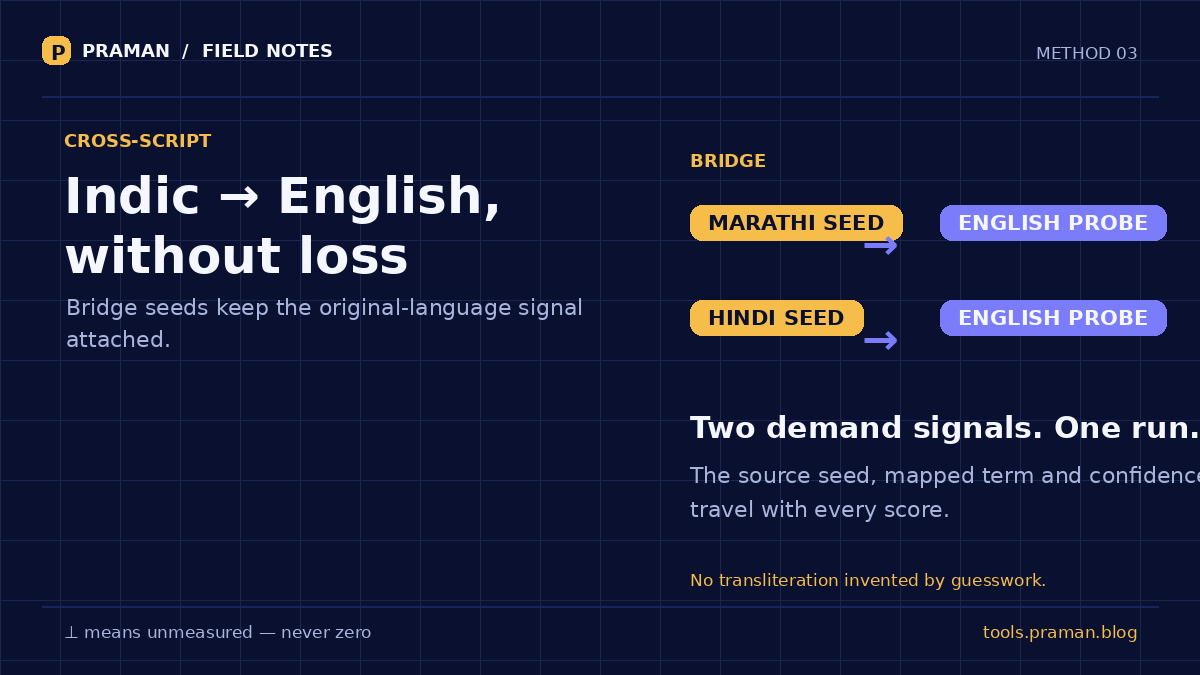
An archive in Marathi and a ranking surface in English are not two research projects. They are two languages in one editorial decision, and splitting them into separate spreadsheets is how the original signal gets lost. You end up planning in English because the English tool had cleaner columns, not because the audience moved.
Praman runs both sides in one pass. It scores observed public autocomplete signals on a deterministic 0–1 demand scale, keeps the native-script evidence visible, and exports the run with its provenance intact.
Key takeaways
- Keep the original-language seed in the run; do not replace it with a transliteration.
- Cross-script Latin variants are an explicit option, not a silent substitution.
- Both languages use the same four voices and the same pinned weights.
- ⊥ marks unmeasured probes on either side; it is never coerced into zero.
- Mode labels and saved exports make an Indic-to-English comparison defensible.
Why the bridge matters
Translation is not evidence
Turning a Marathi seed into an English phrase gives you something a Latin-first tool can process, but it also removes the script, word order and local qualifiers that made the seed useful. The resulting suggestion list belongs to a different question. If the goal is to understand what people actually type, the observation has to start from what they typed.
The ranking surface is often bilingual
A Marathi article may sit beside English results for the same need. Readers move between शेती and “sheti yojana” in the same afternoon. Treating those as separate markets produces two thin plans; treating them as one labelled run lets you see which English queries appear alongside the original-language signal, without pretending they are the same string.
What the method measures
Every Praman run, in any language, uses four pinned voices: breadth 50%, coverage 25%, density 15%, depth 10%. Breadth counts expansion probes that returned suggestions. Coverage checks whether the head query did. Density counts question-shaped suggestions. Depth measures where the seed sits in the ranked list. The weights never change, and they are never renormalised when a probe is missing. A measured empty result is 0.0; a probe that failed or was never reached is ⊥ and stays ⊥ in the export.
Worked example: one run, two scripts
- Start in the app with a native seed such as शेती. Add a second seed in the same language and one English seed for the topic you are comparing against.
- Run it first in Demo. The run is labelled DEMO · SYNTHETIC FIXTURES: sample data for learning the interface, not a market observation.
- Turn on cross-script Latin expansion and run again. You should now see Romanised variants such as “sheti yojana” alongside the preserved Devanagari suggestions.
- Switch to Live for real public suggestions. Live calls Google autocomplete server-side, needs no API key, and is labelled LIVE · GOOGLE AUTOCOMPLETE · RESULTS VARY. Question probes follow the grammar of the language, so काय-type forms can register in the density voice.
- Export the run as CSV and JSON. Compare the four voices for each seed and note any ⊥ cells before you write the brief.
The output is not a translation table. It is a side-by-side record of what each script surfaced, scored on the same scale, with the mode label attached. If the English topic looks stronger, you can now say which voice made it stronger. If a cell is ⊥, you know not to treat it as absence.
The original-language signal is not a footnote to the English plan. It is the reason the plan exists.
What this does not tell you
Praman does not provide exact search volume, guaranteed rankings or private competitor data. Results depend on public suggestions at run time, so Live runs vary; Replay restores recorded inputs when you need consistency. Demand is not competition, and neither is a traffic forecast. Read the methodology for the exact definitions before presenting a score.
Common questions
Does Live need an API key?
No. It calls Google public autocomplete server-side. Optional AI features, if you choose them, use your own key; the demand scoring does not depend on them.
Can I revisit the same comparison later?
Yes. Runs are saved and exportable as Markdown, CSV, JSON and HTML. Load the JSON again to reproduce the same inputs and score.
What to do next
Run one native seed and its English counterpart in Demo, then repeat in Live and export both. Check that the script survived, that the four voices are present, and that ⊥ was not flattened to zero. When the workflow is useful, see the plans.
Leave a Reply