
Hindi searchers routinely write the same intent in several scripts, and no amount of wishful normalisation makes those scripts the same observation. A phrase typed as “keyword research hindi”, the same idea arranged as “keyword research in hindi”, and a Devanagari version of either are three different strings in three different lanes. Romanisation is not a spelling problem to clean up. It is part of the evidence.
Key takeaways
- Romanised Hindi has many plausible spellings; each observed string is a separate data point until evidence justifies grouping.
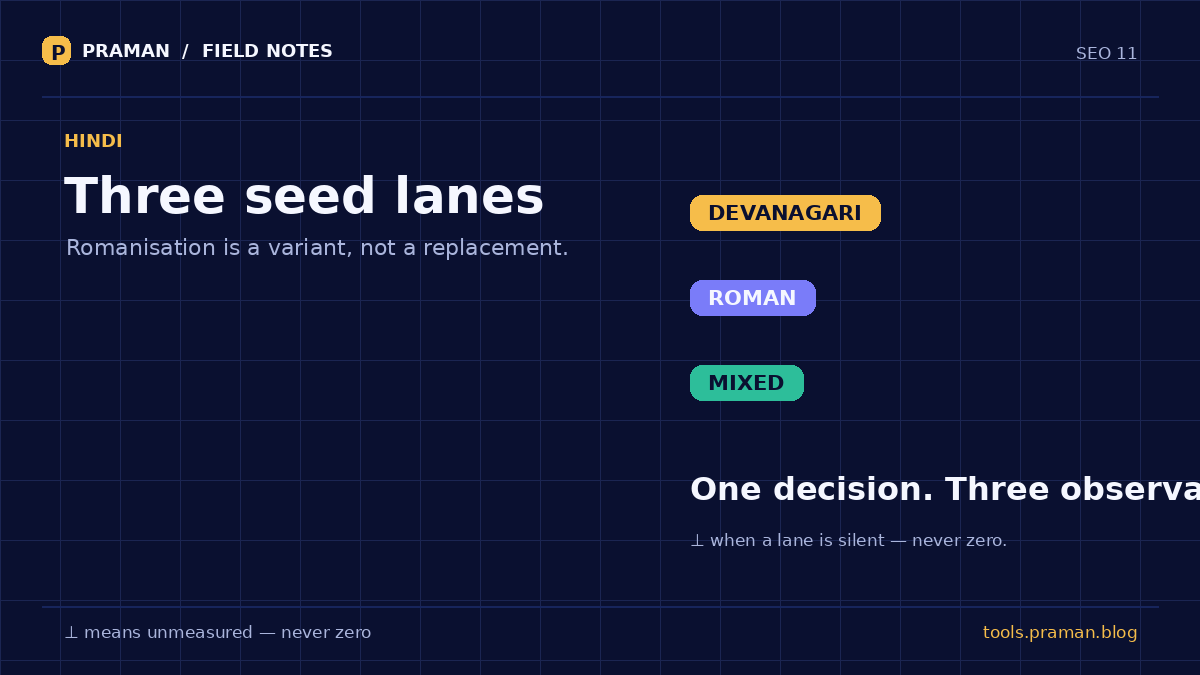
- Run three seed lanes — Devanagari, romanised and mixed script — and keep their scores separate.
- A Hindi-seeded live probe returned both Hindi-marked and English strings; that is overlap evidence, not proof of identical intent.
- Demand is a deterministic 0–1 score from four pinned voices: breadth 50%, coverage 25%, density 15%, depth 10%.
- Unmeasured stays ⊥, including lanes you did not probe. Zero is a measurement claim; ⊥ is not.
- Every row keeps seed, variant, rank, voices, mode and timestamp, with Markdown, CSV, JSON and HTML exports.
The romanisation trap
Romanised Hindi is many-to-one. The same spoken word can appear with different vowel lengths, different consonant spellings and different English neighbours. A tool that canonicalises to one “right” spelling throws away the variation that tells you how people actually type. Worse, it makes the resulting keyword look more popular than any observed string, because several distinct observations have been merged into one tidy label.
Consider the strings from our live Praman probe seeded with “hindi keyword research”: “keyword research hindi” at rank 1, “hindi keyword research tool” at rank 4, “hindi keyword research app” at rank 6 and “hindi keyword research ai” at rank 7. Notice the position of “hindi”: before the topic in some strings, after it in others. That is not noise to be sorted. It is two phrasing patterns, each with its own rank in the same response. A canonicaliser that rewrites both into “hindi keyword research” destroys the distinction.
Praman observes public autocomplete server-side, so no API key is needed, and records each variant as returned. The 0–1 score comes from observed support, never from a monthly estimate.
Romanisation is a lane, not a bug. If you normalise it away, you are scoring a word nobody typed.
Three seed lanes
Before probing, decide which lane each seed belongs to. The lane is a property of the string, not of the person researching. It travels with the row from probe to export.
| Lane | Illustrative seed (proposed, not observed) | Question the lane answers | Forbidden shortcut |
|---|---|---|---|
| Devanagari | हिंदी कीवर्ड रिसर्च | What completions appear in native script? | Transliterating results into Latin before storing |
| Romanised | hindi keyword research | Which Latin spellings and word orders appear? | Merging variants into one canonical spelling |
| Mixed script | keyword research in hindi | When does the language marker attach to the explanation? | Treating the English words as a separate, context-free topic |
These seeds are proposed probes, not observations. Only the strings listed from the live probe are claimed as observed.
Keep the lanes apart through scoring. Breadth, which carries 50% of the demand score, asks how many seeds in a lane produced the variant. Coverage at 25%, density at 15% and depth at 10% are read within that same lane. If you pool all three, a variant that appeared in one Devanagari seed can look comparable to a variant that recurred across romanised seeds. It is not comparable, because the evidence base is different.
Worked three-lane example
The table below shows the observed romanised probe. The Devanagari lane is included as unrun, with ⊥ in the fields that were not measured. This is what a defensible row looks like when you resist filling in a blank.
| Seed | Observed variant | Rank | Lane | Mode | Timestamp |
|---|---|---|---|---|---|
| hindi keyword research | keyword research hindi | 1 | Romanised | Live | recorded per row |
| hindi keyword research | how to do keyword research | 2 | Romanised | Live | recorded per row |
| hindi keyword research | what is keyword research | 3 | Romanised | Live | recorded per row |
| hindi keyword research | hindi keyword research tool | 4 | Romanised | Live | recorded per row |
| hindi keyword research | hindi keyword research app | 6 | Romanised | Live | recorded per row |
| hindi keyword research | hindi keyword research ai | 7 | Romanised | Live | recorded per row |
| hindi keyword research | keyword research in hindi | 34 | Mixed script cue | Live | recorded per row |
| हिंदी कीवर्ड रिसर्च | not probed in this run | ⊥ | Devanagari | not run | ⊥ |
Two things are worth sitting with. First, “how to do keyword research” and “what is keyword research” appeared at ranks 2 and 3 from a Hindi-seeded probe. That is a real cross-language overlap in the observed response. It is not evidence that Hindi searchers and English searchers want the same page, and it is certainly not a volume claim. It is a reason to test a bridging page rather than assume one is needed.
Second, “keyword research in hindi” appeared much later, at rank 34. Rank is position in one response, not a measure of relative demand across the web. Scoring asks whether it recurs across seeds, how completely responses were captured, how phrasing clusters, and how specific the tail gets. Those are the four pinned voices behind the 0–1 score.
Mixed-script queries
Mixed-script Hindi queries are often where intent becomes legible. “keyword research meaning in hindi” is not asking for a tool; it is asking for an explanation in a language. “keyword research in seo in hindi” stacks two topic frames and a language request. Both strings appeared in the same Hindi-seeded probe, at ranks 35 and 36 respectively. Both are English words arranged around a Hindi-language goal.
Do not read minds here. Classify from the string: a language marker such as “in hindi” is a modifier you can observe, while a user’s reason for preferring Hindi is not. Keep the classification as a label beside the variant, with the seed and rank attached. If the label is uncertain, say “unclear” rather than inventing confidence. Commercial cues like “tool” or “app” get the same treatment: visible modifiers, not proof of a purchase plan.
This is also why a mixed-script lane should not be folded into the romanised lane. “hindi keyword research tool” and “keyword research in hindi” differ in where the language marker sits and which page type they suggest. Keep both rows and let breadth decide whether either deserves priority.
Bridging to English demand
An English output is often the practical end of Hindi research: a site architecture decision, a bilingual page, or a report for a team that does not read Devanagari. Bridge deliberately. Export the observed rows first — seed, variant, rank, voices, mode and timestamp — then add English interpretations as a separate layer. Never replace the source variant with its English gloss.
The overlap observed in this probe makes the bridge more interesting than usual. “how to do keyword research” and “what is keyword research” surfaced from the Hindi seed, so an English explainer is a reasonable hypothesis to test. Probe those English strings as seeds in their own right instead of declaring the hypothesis proven from one response. The evidence-first keyword research workflow describes that seed-to-decision loop, and the Marathi-to-English bridge covers the same provenance rule from the other side.
When ⊥ is the honest answer
Our run did not probe a Devanagari seed. Therefore the Devanagari lane is ⊥, not empty, not zero and not a finding about Devanagari search. That distinction becomes important in reports, where a blank cell is easily read as “no demand”. Write ⊥ explicitly and keep it in the export.
Never renormalise the four pinned weights to cover the gap. Breadth stays at 50%, coverage at 25%, density at 15% and depth at 10% whether or not every voice has data. If a voice is unmeasured, the row says so. Likewise, label modes honestly: Live means real observed autocomplete, Demo is free but always sample data, and Replay reads recorded JSON. A Demo row must never be quoted as evidence from a Hindi probe.
When you finish, export the run as Markdown, CSV, JSON or HTML. JSON is the one that preserves the full row structure for a later Replay. That is how a decision made today can still be checked next quarter.
Frequently asked questions
Do different romanisations of the same Hindi word count as one keyword?
Only if you observed them and choose to group them with a stated rule. Until then, each string is its own variant with its own rank and provenance.
Can a Hindi-seeded probe tell me what an English page should target?
It can suggest a hypothesis. Probe the English strings as seeds and score that evidence separately before treating it as a target.
Why is my Devanagari lane marked ⊥ rather than zero?
Because it was not measured. Zero would claim an observation; ⊥ records the absence of one and leaves the four scoring weights untouched.
Web desk
YouTube desk
Run the method on one seed.
Open the workspace, start with a free labelled demo, then switch to Live when you want observed autocomplete with provenance attached to every row and export.
Demo runs are free and labelled. Live and Replay share one run pool across all three desks.
Leave a Reply