
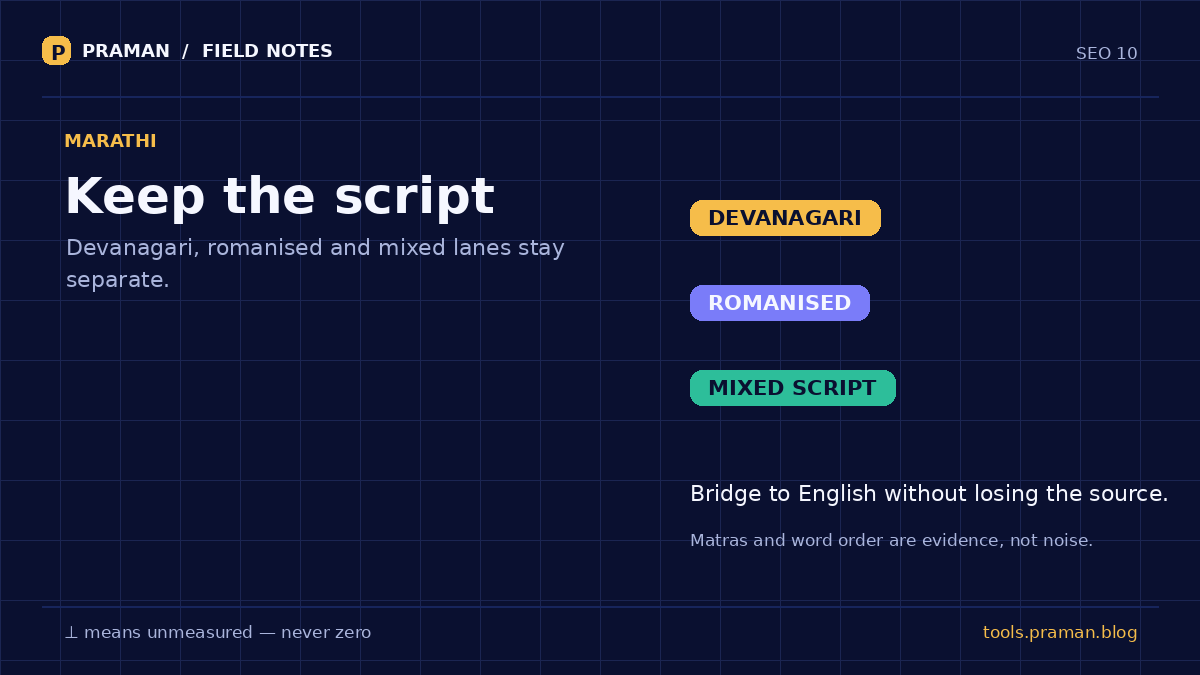
A Marathi query does not arrive in one piece. It arrives as a Devanagari phrase, a romanised approximation typed on a phone keyboard, or a mixed sentence where the subject is Marathi and the tooling words are English. Those three strings can point at the same human need while carrying completely different evidence. A workflow that collapses them into one canonical keyword does not simplify the research; it deletes the thing you were trying to learn.
Key takeaways
- Keep Devanagari, romanised and mixed-script probes in separate lanes; never merge them by transliteration.
- Matras, spelling variation and subject-object-verb word order change what a useful seed looks like and what a normaliser can safely touch.
- Our live Marathi-seeded probe returned Latin-script variants only. That is an observation about that probe, not a claim about Devanagari demand.
- Demand is scored on a deterministic 0–1 scale with four pinned voices: breadth 50%, coverage 25%, density 15%, depth 10%.
- Unmeasured signals stay ⊥. In small-language sets, ⊥ is common and must never become zero or be renormalised away.
- Every row keeps seed, variant, rank, voices, mode and timestamp, and exports as Markdown, CSV, JSON or HTML.
Why Marathi breaks English-first tools
Most keyword tooling assumes a query is a bag of Latin-script tokens. Feed it an Indian language and the pipeline transliterates, lowercases, strips marks, groups “near duplicates” and attaches a number that was never measured in that language. Each step feels harmless. Together they erase the script the searcher actually used.
The loss is not aesthetic. Script choice is a signal: who is typing, on what device, and which pages they are likely to find useful. A Devanagari phrase and its romanised twin may deserve different pages. When a tool reports one merged keyword with one score, you cannot ask that question anymore. This is the failure described in how keyword tools flatten Indian languages, and it shows up first in the seed set, before scoring even begins.
Praman takes the opposite route. It observes public autocomplete server-side — no user API key — and stores the variant string exactly as returned. The score is derived from observed support, not from a volume model that quietly treats Marathi as a sparse version of English.
Script, matras and word order
Devanagari writes vowel signs, or matras, as marks attached to consonants. A normaliser that strips combining marks changes the string, not just its presentation. Two forms that look related to a human become different observations to a machine, and that is fine: the raw forms are the evidence. Keep them raw and let the scoring layer decide how much support each has.
Marathi also follows subject-object-verb order far more readily than English. English-first seed templates that put the commercial modifier at the end can produce phrases a Marathi speaker would not type. Romanisation adds a third complication: the same spoken word can be written several plausible ways in Latin characters, and each spelling is a separate observed string until evidence says otherwise.
| Lane | Illustrative seed (not an observed variant) | What the lane preserves | What it must not do |
|---|---|---|---|
| Devanagari | मराठी कीवर्ड रिसर्च | Native script, matras, actual glyph sequence | Force a Latin canonical form |
| Romanised | marathi keyword research | The Latin spelling people really type | Assume one “correct” romanisation |
| Mixed script | marathi keyword research tool free | Code-mixing, English modifiers, place and price cues | Replace it with a pure-English equivalent |
The table’s seeds are proposed probes, not findings. They exist to show the shape of a script-aware seed set. Only strings that came back from a real probe get the word “observed” attached to them.
Do not let a transliterator rewrite the evidence. The script that produced a variant belongs to the variant forever.
A script-aware seed set
Start with one seed per lane, not one seed total. The Devanagari lane tests native-script phrasing. The romanised lane tests what happens when the same intent is typed on an English keyboard. The mixed lane tests the code-switched sentences that dominate how technical topics are actually discussed. Probe each in the same locale, label the mode, and keep the responses apart.
Our live probe used the Latin-script seed “marathi keyword research”. It returned “marathi keyword research tool” at rank 1, “marathi keyword research tool free” at rank 2, “marathi keyword research app” at rank 3 and “marathi keyword research basic” at rank 10. Every one of those strings is Latin-script. We are not claiming to have observed Devanagari variants from that probe, and we are not claiming any of them has a particular monthly volume. The observation is narrow: these completions appeared, in this order, for this seed, in a live Praman probe.
That narrowness is useful. It tells you that the tooling vocabulary around Marathi keyword research was being completed in English words during this probe. If you want to know whether Devanagari completions appear for a different seed or locale, you run that probe. You do not infer it.
Bridge to English without loss
Marathi research often needs an English deliverable: a page for a national audience, a client deck, or a category name that a content team can act on. Translation is fine as a derived step. The mistake is letting the English version overwrite the source row.
Keep a bridge table with three columns of provenance: the original seed, the original variant with its script lane, and the English interpretation with a confidence label you can defend from the observed support. If a variant appeared under one seed only, say so. If it never appeared, do not manufacture it as a translation. The Marathi-to-English keyword bridge walks through this in detail; the short version is that English demand is a different observation and must not be presented as Marathi demand.
This matters commercially. An English phrase might be the right target for an English page while the original Marathi variant remains the right target for a Devanagari page. Collapsing them into one row loses both decisions.
Worked example
Below is the observed portion of the run, plus one row that was not probed. The ⊥ marks the honest state of that lane in this run — not a conclusion about Marathi search behaviour.
| Seed | Variant | Rank | Lane | Mode | Timestamp |
|---|---|---|---|---|---|
| marathi keyword research | marathi keyword research tool | 1 | Romanised / mixed | Live | recorded per row |
| marathi keyword research | marathi keyword research tool free | 2 | Romanised / mixed | Live | recorded per row |
| marathi keyword research | marathi keyword research app | 3 | Romanised / mixed | Live | recorded per row |
| marathi keyword research | marathi keyword research basic | 10 | Romanised / mixed | Live | recorded per row |
| मराठी कीवर्ड रिसर्च | not probed in this run | ⊥ | Devanagari | not run | ⊥ |
Score the lanes separately. Within the observed lane, a variant found under several seeds gains breadth, which carries 50% of the 0–1 demand score. Coverage at 25% reflects how completely the response was captured, density at 15% reflects clustering of repeated phrasing, and depth at 10% reflects how specific the tail becomes. Pooling the Devanagari lane into this run would not add information; it would hide which script produced the evidence. Provenance — seed, variant, rank, voices, mode and timestamp — is what keeps the lanes separable after export.
Reading ⊥ in small-language sets
In a small-language set, many cells will be empty. That is expected. ⊥ means “we did not measure this”, not “nobody searches for this” and not “demand is zero”. Substituting zero would quietly assert a finding you have not made. Renormalising the four pinned weights to fill the gap would be worse: the weights would change from run to run, and the scores would stop being comparable.
When you meet ⊥, choose an action instead of an assumption. Probe a different seed in that lane. Change the locale and label it as a new observation. Or accept that the lane is unmeasured and let the row stay ⊥ in the export. Demo mode can help you learn the interface, but its sample data must be labelled and must never be used to fill a real gap. Live mode is observed autocomplete; Replay reads previously recorded JSON. Those three modes exist so that a reader can tell where a row came from.
Frequently asked questions
Should I translate Marathi seeds into English before scoring them?
No. Score the string that was actually observed, in its own lane. Translate afterwards as a derived view, carrying the original seed and variant with it.
Do matras matter if most of my audience types in Latin characters?
They matter for the native-script lane and for anything that normalises text. Keep the raw string; do not let a cleanup step decide which marks are meaningful.
Can Praman tell me Marathi search volume?
No. It measures observed autocomplete variants and scores demand on a 0–1 scale with four pinned voices. Volume stays unmeasured rather than being guessed.
What to do next
Run three separate probes in the hosted app: Devanagari, romanised and mixed-script seeds, each labelled by mode and locale. The methodology explains how the four voices combine into a 0–1 score without filling gaps. For the translation step, use the Marathi-to-English bridge and keep the source row attached. If you want the companion treatment of Hindi, read Hindi keyword research beyond romanisation. Export as JSON before you build the deck; Markdown, CSV and HTML are there when you need to share it.
Leave a Reply