
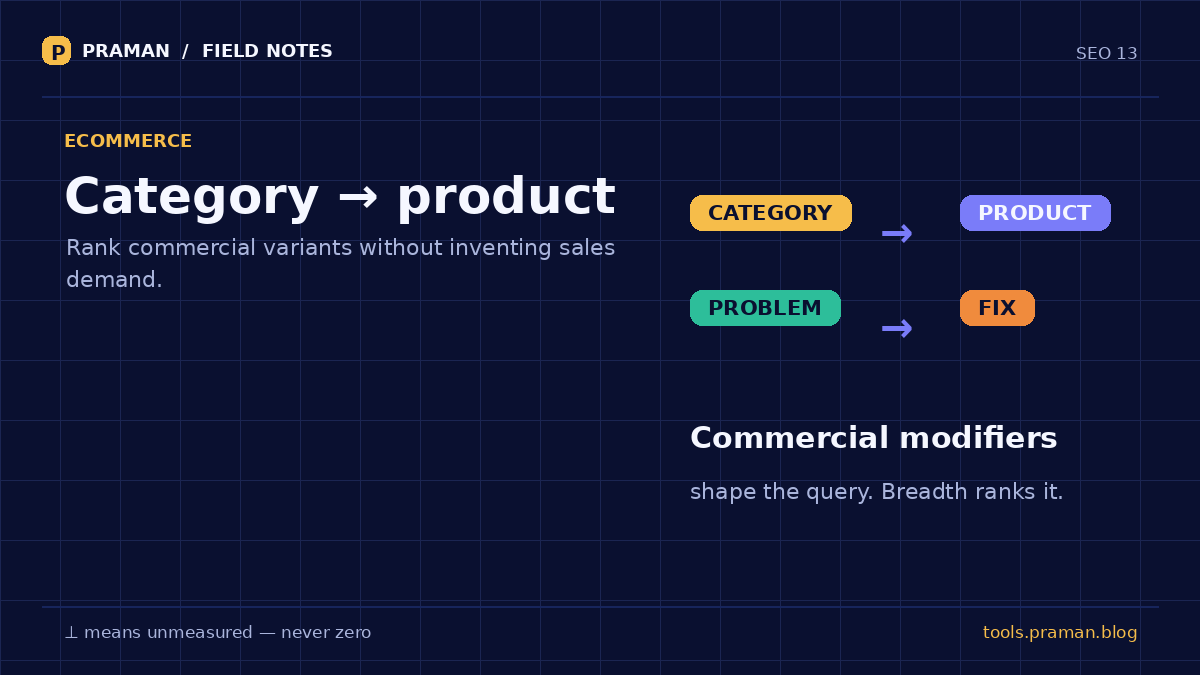
The merchandise meeting usually starts with a number: a marketplace score, an estimated monthly count, a competitor’s category page. Someone draws a conclusion about which collection to build, and nobody can say where the number came from. Ecommerce research deserves better, because its decisions are concrete — a category page gets commissioned, a product page gets rewritten, a filter gets renamed. The evidence for those decisions should be the language shoppers actually complete in a search box, with its source attached.
Key takeaways
- Product pages should not inherit head-term volume guesses from marketplace dashboards.
- Separate category, product and problem queries before assigning any page.
- Commercial modifiers are language signals, not conversion-rate promises.
- Demand is scored 0–1 from observed autocomplete; breadth 50%, coverage 25%, density 15%, depth 10% are pinned.
- Breadth across several product seeds often matters more than a single high rank.
- Unmeasured variants stay ⊥, and every row carries seed, variant, rank, voices, mode and timestamp.
The product-page trap
The trap is simple: take a broad term, assume a volume, and point a single product page at it. Broad terms rarely describe one SKU. They describe a shopping situation — a category, a comparison, a problem — and the page that answers that situation is usually not the page for one specific item. Borrowed marketplace scores make it worse: they belong to a different catalogue, a different audience and a different definition of “search”.
Praman does not produce monthly counts or difficulty values. It scores demand on a deterministic 0–1 scale from observed public autocomplete signals collected server-side, with no user API key. That score ranks evidence strength. It is not sales volume, and it should never be presented as such. If a forecast is what you need, say so explicitly and use a method that can defend it; do not smuggle a forecast into an ecommerce keyword sheet under the label “volume”.
Three query layers
Before you probe, decide which layer a seed belongs to. The layer determines the page you can honestly build.
| Layer | Typical seed form | Page it can justify | What to watch |
|---|---|---|---|
| Category | product type, material, use case | Category or collection page | Filters and facet language |
| Product | brand + model, size, variant | Individual product page | Whether the variant is stable or seasonal |
| Problem | symptom, task, occasion | Guide that links into category | No product name in the query at all |
The strings in that table are seed forms, not observed results. That distinction matters: inventing an example variant and then quoting it as evidence is the same error as inventing a volume, just with fewer decimal places.
Worked category probe
Here is an observed run from a live Praman autocomplete probe on the seed ecommerce keyword research, captured in India in November 2026. The variants are real observations with real ranks; they are about the research task itself, and they demonstrate how to read a run before you apply the method to your own catalogue.
| Observed variant | Rank | Seed | Reading |
|---|---|---|---|
| ecommerce keyword tool | 1 | ecommerce keyword research | Tool framing dominates the nearby language |
| ecommerce keyword search | 2 | ecommerce keyword research | Plain search framing sits close behind |
| ecommerce keyword research tool | 3 | ecommerce keyword research | The head term extends into a tool phrase |
| ecommerce keyword research tool free | 4 | ecommerce keyword research | A price-modifier variant, labelled transactional in the run |
Now transpose the workflow to a real category. Choose one category seed, then two or three adjacent seeds: a use case, a material or attribute, and a problem. Probe them as separate runs. Compare which variants recur across those seeds. A modifier that appears under several seeds is stronger evidence of a category-level concern than a single variant that happens to rank first once. The 0–1 score reflects that pattern; it does not need a monthly count to be useful.
The four voices stay pinned throughout: breadth 50%, coverage 25%, density 15% and depth 10%. You cannot reweight them to make a favourite product look more demanded. If a collection has strong breadth but thin depth, the report should say so plainly rather than hiding it behind a single composite number.
Commercial modifiers
Words such as free, best, price, review and near me are modifiers of language, not proof of purchase intent. In the observed run above, ecommerce keyword research tool free carried a transactional label; that label is a classification of the query form recorded in the run, not a claim about anyone’s likelihood to buy. Keep it as an attribute on the row.
For merchandising, the useful question is what the modifier asks the page to answer. A price modifier calls for clear pricing; a comparison modifier calls for a comparison table; a size or fit modifier calls for a size guide. That is a defensible brief because it is traceable to an observed string. A conversion curve would be a different claim, and Praman does not manufacture one.
Breadth across products
Product catalogues tempt you to rank variants one SKU at a time. Breadth punishes that habit. In Praman, breadth carries 50% of the pinned weighting: a variant observed under several seeds is stronger than one observed under a single seed, even when the single-seed variant sits higher in the list. Coverage contributes 25%, density 15% and depth 10%.
That is why a three-seed run beats one exhaustive head probe. If free language appears under your category seed, your use-case seed and your problem seed, you have a pattern to put on the collection page. If it appears once at rank 1, you have a variant to note and revisit. Both are legitimate outcomes; only one deserves a redesign.
A category page should earn its place from a pattern of observed variants, not from a number someone typed into a spreadsheet.
The ⊥ boundary
Every catalogue has long tail SKUs, seasonal items and Script-mixed queries nobody probed. Those cells stay ⊥. ⊥ never becomes zero, and it is never folded into an average that quietly treats missing evidence as weak evidence. A zero says you measured and found nothing; ⊥ says you have not measured. In a merchandising review, that difference decides whether a product line is deprioritised or simply left unexamined.
Mode is part of the same discipline. Live rows are real observed autocomplete; Demo rows are free sample data and must always be labelled as such; Replay rows come from recorded JSON and let you re-check a past decision. Never build a category business case on unlabelled sample output.
From research to merchandising
A clean handoff needs rows, not screenshots. Praman saves runs and exports them as Markdown, CSV, JSON and HTML, each carrying seed, variant, rank, voices, mode and timestamp. The JSON or CSV belongs in your catalogue planning sheet; the Markdown or HTML belongs in the content brief. The argument for this format is set out in from spreadsheet to decision export format.
In keyword research that shows its work, the standard is that someone can audit a decision without re-running your life. Attach the layer to each row, attach the place and script where relevant, and let the ⊥ cells speak. Your category page then rests on language you can point to, not a number you inherited.
FAQ
Can Praman tell me which product will sell most?
No. It measures observed autocomplete language and scores demand from 0 to 1. Sales forecasting needs your own transaction data; Praman does not substitute a marketplace estimate for it.
Should category pages and product pages chase the same variant?
Usually not. A variant that names a type, material or use case points to a category page; a variant that names a model or size points to a product page. Assign by observed language, not by which page needs traffic.
What if a high-ranking variant appears under only one seed?
Keep it as a real observation with its rank and provenance, but do not promote it to a strategy on breadth grounds. Re-probe with adjacent seeds; if it stays single-source, treat it as a narrow signal.
Web desk
YouTube desk
Run the method on one seed.
Open the workspace, start with a free labelled demo, then switch to Live when you want observed autocomplete with provenance attached to every row and export.
Demo runs are free and labelled. Live and Replay share one run pool across all three desks.
Leave a Reply