
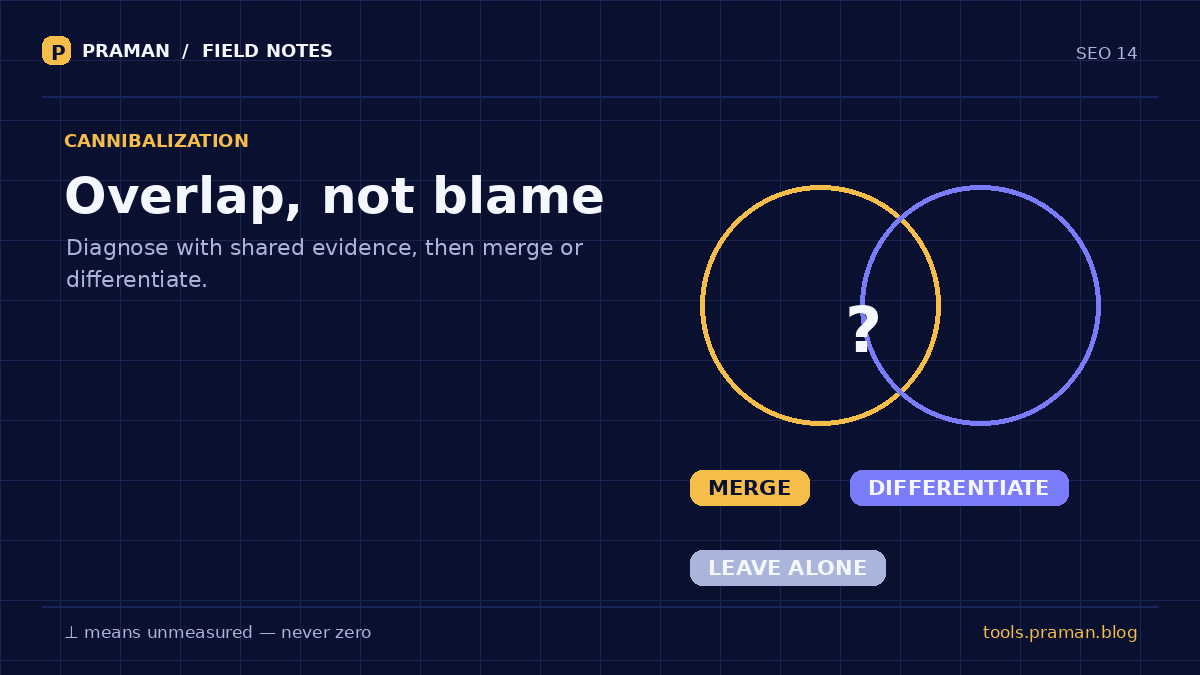
Cannibalization is usually diagnosed from a chart: two URLs slip, someone finds they both mention the same phrase, and a merge ticket is opened by lunch. That is a story about rankings, not evidence about language. The question worth asking is narrower and more answerable: do these two pages rest on the same observed seed and variant set, or do they serve different completions that happen to share a head word?
Key takeaways
- Cannibalization is an evidence-overlap problem, not a moral failing or a chart-reading exercise.
- Overlap means shared seeds and observed variants, with ranks and provenance attached.
- Two pages sharing one seed is a question, not a verdict.
- Demand stays on a deterministic 0–1 scale with breadth 50%, coverage 25%, density 15%, depth 10% pinned.
- Use a decision table: merge, differentiate or leave alone.
- Unprobed pages and queries stay ⊥, never zero; every row keeps seed, variant, rank, voices, mode and timestamp.
What cannibalization actually means
In plain terms, cannibalization is two or more URLs competing for the same query. That definition is easy to say and hard to apply, because “the same query” is rarely a single string. A definition page and an examples page may both target a head term while attracting different completions: one pulls meaning language, the other pulls example language. The head term is shared; the evidence is not identical.
A measured approach starts with what autocomplete actually emitted. Praman probes public Google autocomplete server-side, records the variant strings and their ranks, and scores demand on a deterministic 0–1 scale. There are no invented volumes and no borrowed difficulty scores in the record. What you get is a set of rows you can compare between two pages’ topic seeds — which is exactly the comparison a merge decision needs.
Why single-keyword thinking causes it
The common root cause is a spreadsheet with one keyword per row and one row per page. That model assumes a query is a unique key, when observed language is a cluster. Editors optimise two pages toward the same head word, both collect overlapping modifiers, and later someone treats the resulting competition as proof that one page was wrong all along.
There is a second failure mode: treating a ranking drop as diagnosis. A drop can follow a site change, a fresh result, a seasonal shift or a dozen other causes. Without the seed and variant evidence for both pages, blaming cannibalization is a guess with a confident name. The pillar workflow exists to replace that guess with recorded observations.
Structure gets blamed because it is visible, while the research that produced it is not. A tidy site tree with two sibling pages for one variant family looks like the cause; the real cause may be a brief that never recorded which variants each page was meant to own. Put the observed strings into the brief and the structural fix usually becomes obvious: retitle a page, point an internal link at the variant it owns, or combine two pages whose evidence is indistinguishable. None of those actions requires a new volume estimate.
Evidence overlap matrix
Below are observed strings from a live Praman autocomplete probe on keyword cannibalization, run in India in November 2026. The variants and ranks are real. The two pages are illustrative: imagine you have a definition page and an examples page, and you are deciding whether they should stay separate.
| Observed variant | Rank | Seed | Definition page | Examples page |
|---|---|---|---|---|
| keyword cannibalization in seo | 1 | keyword cannibalization | Shared context, not decisive | Shared context, not decisive |
| keyword cannibalization meaning | 2 | keyword cannibalization | Direct match | Peripheral |
| keyword cannibalization example | 3 | keyword cannibalization | Peripheral | Direct match |
| keyword cannibalization analysis | 6 | keyword cannibalization | Weak match | Possible match |
Read the matrix as a set of claims, not a scoreboard. Two rows are shared context; two split cleanly by modifier. That pattern argues for differentiation, not merger. A page assignment in the last two columns is your editorial mapping, not something autocomplete decided — keep it visibly separate from the observed columns so nobody mistakes an opinion for a measurement.
Two pages sharing a seed is a question, not a verdict; the verdict lives in the variants.
Worked example
Now run the comparison as a workflow. Treat keyword cannibalization as the shared seed already probed above. Add a second seed for the examples page — keyword cannibalization example — and a third for the definition page, such as what is keyword cannibalization. These are seeds to run, not strings claimed as observed here.
- Probe each seed in Live mode and keep the runs separate.
- List the observed variants for each run with rank, seed and timestamp.
- Mark variants that recur under two or more seeds; that recurrence is breadth, the heaviest pinned voice at 50%.
- Note coverage at 25%, density at 15% and depth at 10% without reweighting to favour a preferred page.
- Compare the two variant sets cell by cell. Shared variants with similar ranks suggest overlap; distinct modifier families suggest separation.
- Mark any page or query you did not probe as ⊥ rather than assuming absence of overlap.
The result is a 0–1 demand picture for each topic, grounded in observed strings. It will not tell you which URL Google prefers this week. It will tell you whether your two pages are answering the same observed language — which is the part you control.
Merge, differentiate or leave alone
Once the overlap matrix is filled, use a decision table with explicit conditions. No option is automatically virtuous; merging pages that serve different variants can destroy useful distinctions.
| Observation | Decision | Reason |
|---|---|---|
| Near-identical variant sets across both pages | Merge | Two pages are answering the same observed language |
| Shared seed, distinct modifier families | Differentiate | Keep pages, sharpen headings and internal links to the variants each owns |
| Overlap only in broad context, variants mostly distinct | Leave alone | Competition is assumed, not evidenced |
| Either page’s evidence unprobed | Probe first | ⊥ is not a finding of no overlap |
Put the action in the same export as the evidence. Praman runs are saved and exportable as Markdown, CSV, JSON and HTML, with seed, variant, rank, voices, mode and timestamp on every row. A merge ticket that links to that file can be reviewed months later; one that links to a screenshot cannot.
Where ⊥ matters
Cannibalization audits are usually partial. You probe the pages in the contested navigation, not every page in the site. Everything you did not probe stays ⊥ — unmeasured, not zero, and not silently renormalised into a tidy overlap percentage. If a third page might own analysis language, mark it ⊥ and go probe it before merging anything.
Mode belongs in the same note. Live means real observed autocomplete; Demo is free sample data and must be labelled as such; Replay is recorded JSON used to reproduce a past run. A decision based on unlabelled demo strings is not a diagnosis at all. The distinction is explained in unmeasured vs zero and in keyword research that shows its work.
FAQ
If two pages rank for the same phrase, is that always cannibalization?
No. It is a prompt to compare their observed variant sets. If the pages own distinct modifiers, the overlap may be harmless context rather than competition.
Can a 0–1 demand score tell me which page to keep?
It tells you which topic has stronger observed evidence under the pinned voices. The keep-or-merge decision also needs your page mapping, internal links and commercial context; the score does not make it for you.
Should I merge first and measure later?
No. Probe both topics first. If a page’s evidence is ⊥, merging on assumption destroys the information you needed to make the call.
Web desk
YouTube desk
Run the method on one seed.
Open the workspace, start with a free labelled demo, then switch to Live when you want observed autocomplete with provenance attached to every row and export.
Demo runs are free and labelled. Live and Replay share one run pool across all three desks.
Leave a Reply