
A zero in a regional-language row is usually a statement about the tool, not the market. If you publish for an Indian audience, you have seen it: a topic you know people discuss returns an empty result, or the tool hands back a rough transliteration nobody would actually type. The topic is not missing. The method is.
Indian language search is not English search with different characters. It has its own scripts, its own word order, and a daily habit of mixing both in a single query. A tool built around Latin-alphabet data will flatten all three and call the result a measurement.
Key takeaways
- Blank rows in Indic scripts often mean the tool never probed the right string.
- Matras and combining marks carry meaning; normalising them away breaks the evidence.
- Script mixing is normal, so cross-script Latin expansion should be a choice, not a silent substitution.
- Question probes must follow the grammar of the language, not an English template.
- The same four voices and the same pinned weights apply in every language, so runs stay comparable.
Where English-first tooling goes wrong
Regional languages arrive as a filter
Many keyword suites were designed around clickstreams from US and European markets. Regional languages were added later as a dropdown, not rebuilt as a workflow. The result is thin suggestion coverage, blank rows, and quiet pressure to translate everything into English before planning it. Translation is not measurement: it replaces the thing you wanted to observe.
Devanagari folding loses the word
In Devanagari, matras and combining marks are part of the word. Normalise them away, or treat a Devanagari seed as if it were a Latin string, and related queries stop looking related. A seed such as पीक विमा and its question forms can land in different buckets or disappear altogether. The same problem appears across Brahmic scripts, not only Devanagari.
Script mixing is the norm
Someone types शेती in one message and “sheti yojana” in the next. English modifiers get dropped into Indic sentences. A tool that probes only one script sees half the surface, then reports that bilingual demand is small when it never looked for it. Replacing the native script with Latin characters is not a fix; it discards the script, the word order and the local qualifiers that say what the person wants.
SOV questions do not look like English questions
Marathi and Hindi follow subject-object-verb order. Interrogatives and modifiers sit where an English template would not put them. If expansion uses English-style question phrases, it misses काय, किती, कधी and their equivalents across other languages. Informational intent then vanishes into an empty row instead of showing up as question density.
Measurement that keeps the script intact
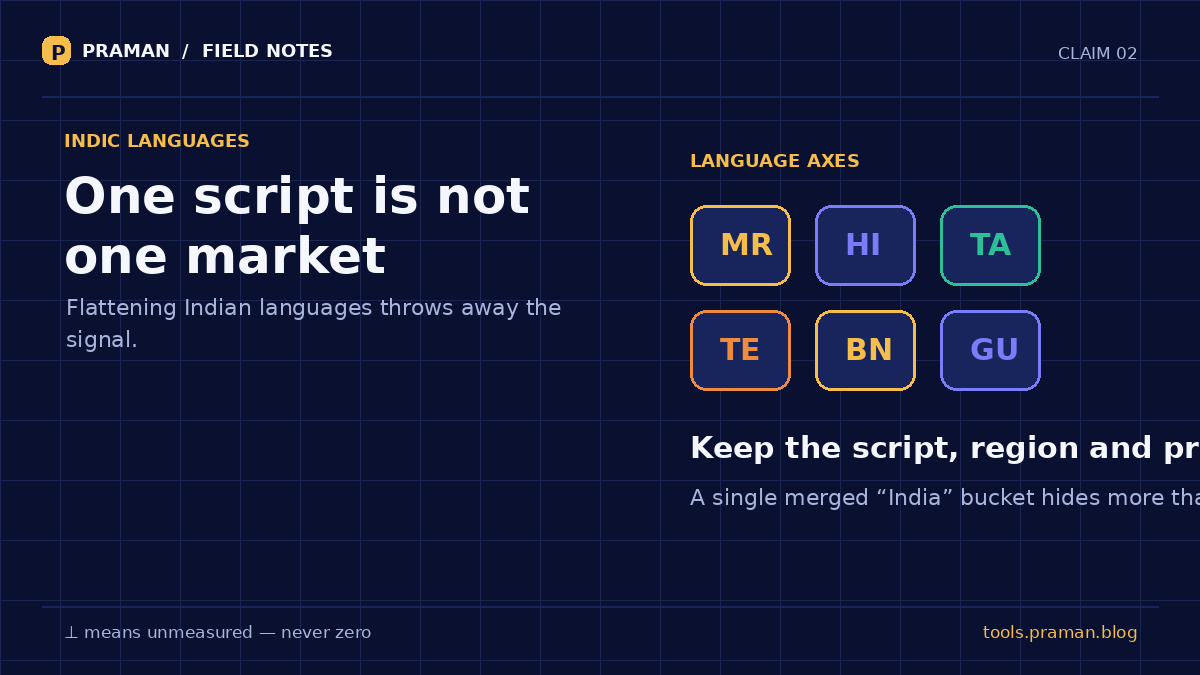
Praman treats language as part of the measurement, not a display setting. One workflow covers Marathi, Hindi, Tamil, Telugu, Bengali, Gujarati, Kannada, Malayalam, Punjabi, Odia and English. Every run scores observed public autocomplete signals on the same deterministic 0–1 scale, with the same four pinned voices: breadth 50%, coverage 25%, density 15%, depth 10%.
Script-aware expansion
Seeds are expanded with native consonants, modifiers and question probes in the selected language. Combining marks are preserved, so observations stay grouped with the language they came from. Cross-script Latin expansion is an explicit option: ask for Romanised variants such as “sheti yojana” when you want them, rather than having them silently substituted for the original.
Intent markers in the right place
Question probes use the grammar of the language, placing interrogatives where a speaker would place them. That lets informational intent register in the density voice instead of being lost to a mismatched template. You can inspect the suggestion lists behind an intent label rather than trusting a badge.
An Indic-to-English bridge
A seed in your language and the related English topic can be explored in one run. That matters when the archive is in Marathi but much of the ranking surface is English. The bridge does not translate for its own sake; it shows which English queries appear alongside the original-language signal, with the same voices behind both. Unmeasured probes remain ⊥ on either side, and the mode label carries the provenance.
Quick check on your own seeds
- Pick one real Indic seed, such as शेती or पीक विमा.
- Run it with native expansion, then with cross-script Latin expansion on.
- Read the suggestion lists, not just the score. Did the script stay intact?
- Repeat with an English seed and compare the four voices side by side.
If a tool cannot show you what it observed, it is asking you to trust a summary you cannot check.
What this does not tell you
Praman does not claim that one language ranks better than another and does not provide exact search volume. Live results depend on public suggestions at run time, so they vary. Demo is labelled sample data for learning the workflow; use Replay when you need the same inputs again. Definitions are in the methodology.
What to do next
Open the app and enter one Indic seed and one English seed in Demo. Export both runs as CSV and check that the script, the four voices and any ⊥ values survived the export. Then run Live with the same seeds — no API key required. Plans are on the pricing page.
Leave a Reply