
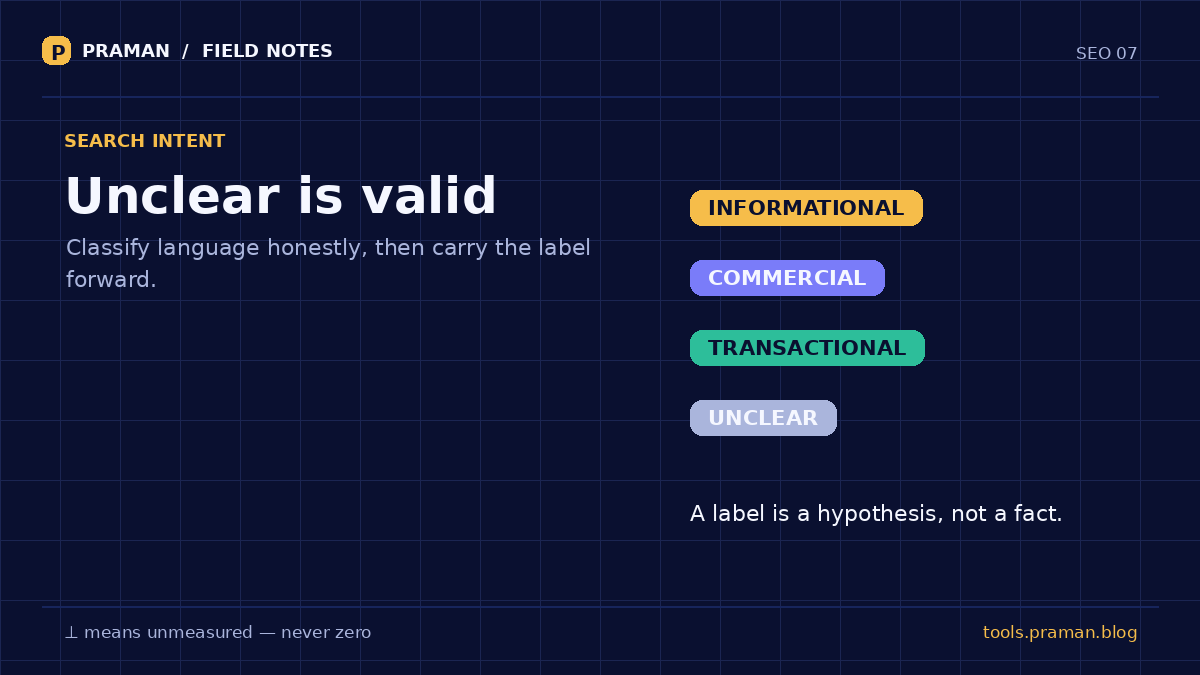
“That one feels informational.” Intent is often decided in the gap between a keyword list and a content calendar, by gut feel and a few examples. The label then hardens: a page is commissioned, a template is chosen, and nobody asks what made the classification defensible. Intent is a classification of language, not mind-reading. You can observe the words people type, the seed that produced them and their rank in a probe. You cannot observe what they meant. A method that respects that boundary will classify with uncertainty attached, and it will keep an unclear bucket.
Key takeaways
- Intent labels are your taxonomy, not facts emitted by a search engine.
- Classify the query form — how to, meaning, tool, brand — and record the signal you used.
- “Unclear” is a valid outcome. Force-fit labels are worse than an honest blank.
- ⊥ is a measurement state, not a classification: unmeasured signals stay unmeasured, never zero, never renormalised.
- Provenance travels with the label: seed, variant, rank, voices, mode and timestamp, in every export.
What intent labels really are
Informational, navigational, commercial, transactional and how-to are buckets we impose on strings to make content decisions. They are useful precisely because they are compact, and dangerous precisely because they feel like observations. Autocomplete gives you phrasing. It does not give you a user’s purchase stage.
Consider a live Praman autocomplete probe in India (November 2026) on the seed search intent. It returned search intent in seo at rank 1, search intent meaning at rank 2, search intent types at rank 3 and search intent analysis at rank 5. A separate seed cluster produced keyword research and search intent at rank 12. The same probe set also emitted what is search intent, search intent examples and language-mixed strings such as search intent là gi and search intent adalah. These are observed strings from one and two seed clusters, not volume estimates and not cross-seed consensus.
Only some of those strings have an obvious label. what is search intent is definition-shaped. keyword research and search intent is a compound phrase whose task is ambiguous. The language-mixed variants show that a query can be about the same concept while sitting outside your English taxonomy entirely. A rubric has to survive all three cases.
A transparent rubric
Write down the signal, the label it supports and the confidence you actually have. Confidence here means “explicit in the string” or “inferred from context”, not a made-up percentage. If no signal is explicit, the row is unclear.
| Observable signal in the variant | Label to consider | When to stop and mark unclear |
|---|---|---|
| what is, meaning, definition, examples | Informational | Compound with a tool or brand term |
| how to, guide, steps, tutorial | How-to | No action verb, only a noun phrase |
| tool, checker, free, finder, pricing | Transactional or commercial | Modifier attaches to a different noun |
| Brand or product name plus a site-like phrase | Navigational | Brand used as a generic term |
| Mixed language, fragment, unfamiliar syntax | Unclear | No reliable parser for the script |
The rubric classifies text. It does not replace a demand score. Praman scores observed public autocomplete signals on a deterministic 0–1 scale, with four pinned voices: breadth 50%, coverage 25%, density 15% and depth 10%. Those voices describe how strongly a variant is evidenced across seeds and chains. They do not tell you what a searcher wants. Keeping the two outputs separate is what makes the classification auditable.
Worked classification
Apply the rubric to the observed rows rather than to an idealised keyword list. Each row keeps its seed and rank, because context is part of the classification.
| Observed variant | Rank | Signal | Label | Why |
|---|---|---|---|---|
| search intent meaning | 2 | “meaning” | Informational | Explicit definition wording |
| search intent types | 3 | Taxonomy noun | Unclear | Could be definition or reference lookup |
| search intent analysis | 5 | Process noun | Unclear | No verb; task not explicit |
| keyword research and search intent | 12 | Compound phrase | Unclear | Two topics, no dominant modifier |
| what is search intent | 22 | “what is” | Informational | Explicit question form |
Two unclear rows out of five is not a failure. It is an accurate description of the evidence. A classifier that labels every row confidently is usually hiding its assumptions in the ones you did not read.
The unclear bucket and the ⊥ boundary
These two concepts are easy to confuse and should not be. Unclear is a classification outcome: the string was observed, but its task cannot be pinned down from its form. ⊥ is a measurement state: a signal was not probed, or a context was not covered, so there is no value to report. Praman treats ⊥ as a first-class result. It is never zero, and it is never silently renormalised into an average.
In practice, a row might have a well-evidenced 0–1 demand score, an unclear intent label and ⊥ for a locale you did not probe. That is a coherent state, not a broken export. Forgetting the distinction produces two common errors: calling absence of data zero, and calling ambiguity a fact. The essay on unmeasured versus zero covers the first error in detail.
Label what the string says. Leave ⊥ where you did not look. Never let a tidy label invent a missing measurement.
Commercial modifiers
Commercial and transactional labels are where guesswork does the most damage. Modifiers are observable text; buyer stage is an inference. In a live probe on the seed keyword research, keyword research tool free appeared at rank 2 and keyword research best tools at rank 26. In a separate probe on competitor keyword research, competitor keyword research tool free appeared at rank 2. A probe on google autocomplete produced google autocomplete api pricing at rank 9. Each row shows a modifier — free, best, pricing — and each can be classified as commercial-shaped with the signal named. None of them demonstrates a purchase, a budget or a conversion rate.
The useful question is not “is this transactional?” but “which observable modifier made me say so, and would a different reader agree?” If the answer depends on a hunch about the searcher, write unclear and move on.
Intent in the export
An intent label without provenance is just a coloured cell. Praman keeps seed, variant, rank, voices, mode and timestamp with each row, including after classification. Live mode is real observed autocomplete. Demo mode is free but always labelled sample data, so sample-derived labels cannot be mistaken for evidence. Replay uses recorded JSON, letting you reproduce the exact probe behind a label. Saved runs export as Markdown, CSV, JSON and HTML; JSON is the format that preserves the label alongside its evidence trail most cleanly.
The hosted app is at tools.praman.blog/app, and the scoring rules are set out at the methodology page. The local ZIP product is separate; do not blend its output with hosted runs. If you want to see how intent labels interact with page grouping, read keyword clustering from autocomplete evidence.
FAQ
Is “unclear” a failure of the tool?
No. It is the correct label when a string lacks an explicit task signal. A method that never produces unclear is either over-confident or hiding its rules.
Can I override a label after reviewing the page results?
Yes, but record the override and the reason. Your review is a new piece of evidence; it should not erase the original classification or its provenance.
Do the four voices change an intent label?
No. Breadth, coverage, density and depth score how well a variant is evidenced. Intent classifies the wording. Keep the outputs independent so neither can quietly justify the other.
Web desk
YouTube desk
Run the method on one seed.
Open the workspace, start with a free labelled demo, then switch to Live when you want observed autocomplete with provenance attached to every row and export.
Demo runs are free and labelled. Live and Replay share one run pool across all three desks.
Leave a Reply