
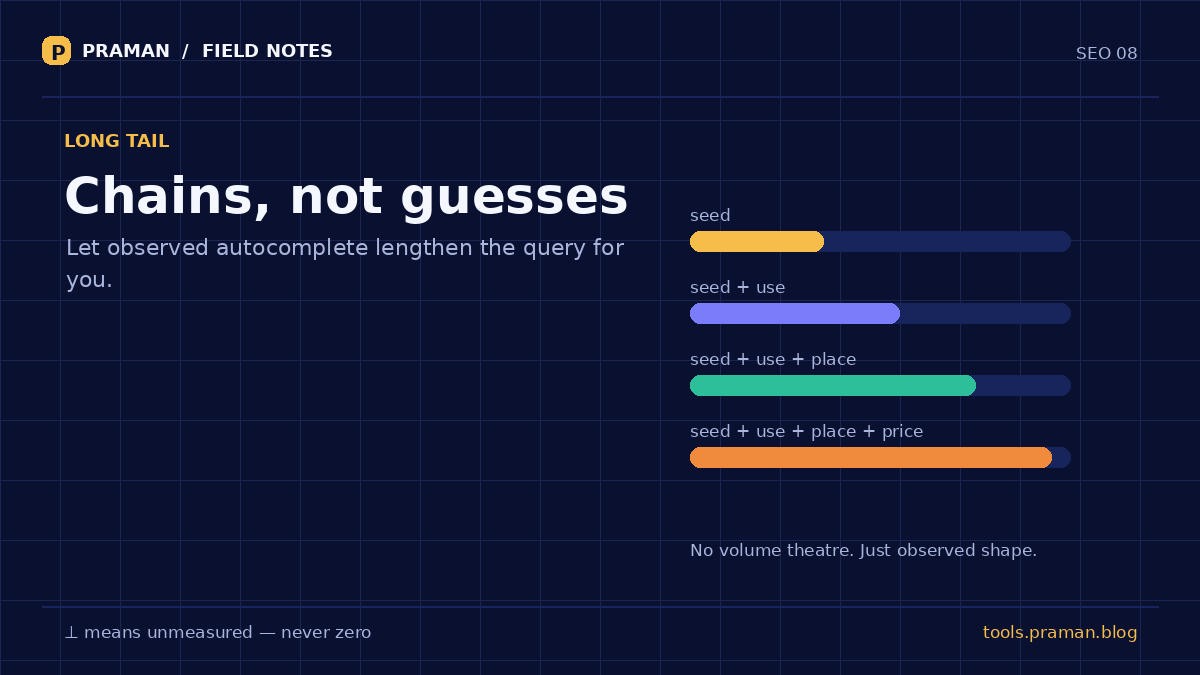
“Long tail” is the most comforting phrase in keyword research. It suggests small, cheap, winnable queries hiding just below the obvious ones, and it usually arrives with a promise of volume that nobody can show you. The comfort is misplaced. Word count is not a demand claim, and a three-word phrase is not automatically easier than a two-word one. Long tail is better understood as a shape of evidence: a variant that extends a seed, observed in a probe, with a rank and a lineage you can reproduce. Once you define it that way, the theatre stops and the method starts.
Key takeaways
- Long tail describes a shape of evidence, not a guaranteed traffic shortcut.
- Variants come from observed autocomplete chains, with each extension recorded as a new seed.
- Demand is a deterministic 0–1 score from four pinned voices: breadth 50%, coverage 25%, density 15%, depth 10%.
- ⊥ stays ⊥. A suggestion you did not observe is unmeasured, not zero.
- Provenance travels with every row: seed, variant, rank, voices, mode and timestamp, in Markdown, CSV, JSON or HTML.
What “long tail” should mean
Call a variant long-tail when it extends a seed with a modifier, question or qualifier and was actually emitted by a probe. The important facts are the seed it came from, the rank it appeared at and the depth of the chain. The number of words is a description, not a score. A short variant can carry more evidence than a long one observed once.
In a live Praman autocomplete probe in India (November 2026), the seed long tail keywords emitted long tail keywords and short tail keywords at rank 1, long tail keywords meaning at rank 2, long tail keywords examples at rank 3 and long tail keywords in seo at rank 5. Further down the same probe came long tail keywords should include at rank 7, long tail keywords finder at rank 8 and long tail keywords are more specific at rank 12. These are observed strings and ranks from one seed cluster. They are not monthly volumes, difficulty values or predictions of traffic.
Notice what the list does: it gives you phrasing. long tail keywords examples asks for illustrations; long tail keywords finder asks for a tool; long tail keywords and short tail keywords asks for a comparison. That is enough to plan content. It is not enough to claim anyone searches a given number of times.
Where variants come from
The mechanism is simple but easy to rush. Probe a seed, record the suggestion set, choose a variant worth exploring, then probe that variant as a new seed. Each level adds depth to the chain, and every row keeps the seed that produced it. Depth is one of the four pinned voices, weighted 10%, because a variant found three levels down is different evidence from one sitting at the top of a single probe.
Praman measures observed public Google autocomplete signals server-side, with no API key needed from the user. Demand is scored on a deterministic 0–1 scale, never as an invented monthly volume. If you want the argument against volume-first research, see why keyword volume is a guess.
Worked expansion
Start with the observed seed long tail keywords. Its probe gives you the ranked variants above. Pick two of them as second-level seeds and probe separately. Do not assume the second probe will repeat the first; record what it actually returns.
| Level | Seed used | Observed variant | Rank | What it adds |
|---|---|---|---|---|
| 1 | long tail keywords | long tail keywords and short tail keywords | 1 | Comparison framing |
| 1 | long tail keywords | long tail keywords examples | 3 | Example request |
| 2 | long tail keywords examples | Reprobe and record only emitted strings | — | Depth, with new provenance |
| 2 | long tail keywords in seo | Reprobe and record only emitted strings | — | Domain-specific extension |
The second-level rows are deliberately blank on rank. Inventing a plausible rank would turn a method article into fiction. Once you run those probes, the ranks and variants fill in, and the chain becomes evidence you can replay. That is the whole discipline: extend, observe, record.
Ranking without volume
Long-tail sets need ordering because they are large and uneven. Praman’s demand score runs from 0 to 1 and is built from four pinned voices. Breadth carries 50%: how many of your seeds produced the variant. Coverage carries 25%: how much of the observed suggestion set you captured. Density carries 15%: how tightly related variants gather around a seed. Depth carries 10%: how far down a chain the variant appears.
For long-tail work, breadth is the voice that does the most work. A phrase emitted by five different seeds is a stronger pattern than the same phrase emitted once, even if the single observation appeared at rank 1. Depth rewards genuine chains, not wordiness. Because the weights are fixed, the score is deterministic and repeatable; you cannot nudge it until your favourite phrase wins.
Scoring is not classification. A commercial-shaped modifier such as long tail keywords finder can be noted without claiming a sale, and a definition-shaped string such as long tail keywords meaning can be classified without claiming a reader’s intent. For a rubric that keeps those claims separate, see search intent with provenance.
A long tail is a chain of observations, not a promise of cheap traffic.
The ⊥ boundary
Autocomplete is silent about a great deal. It does not publish monthly searches, competition or conversion rates, and it may return nothing for a phrase or locale you expected it to know. Those signals remain ⊥: unmeasured, never zero, never silently renormalised into a score. A missing suggestion is not proof of missing demand; it is a gap in what you observed.
Mode labels make the boundary visible. Live mode is real observed autocomplete. Demo mode is free but always marked sample data, which is fine for learning the interface and not fine for a content decision. Replay uses recorded JSON, so a colleague can inspect the same chain you saw. Runs are saved and exportable as Markdown, CSV, JSON and HTML. Every row carries seed, variant, rank, voices, mode and timestamp. The hosted app is at tools.praman.blog/app; the downloadable ZIP is a separate local product, not another sales path for the same hosted run.
Long-tail to article outline
Convert clusters of variants into sections, not into a single catch-all post. The observed strings already tell you which questions readers phrase aloud.
- Comparison wording (long tail keywords and short tail keywords) → a section that defines the contrast.
- Definition wording (long tail keywords meaning) → a short, explicit definition near the top.
- Example wording (long tail keywords examples) → a table of observed seed and variant pairs.
- Tool wording (long tail keywords finder) → a separate evaluation page with its own probe.
- Process wording (how to create long tail keywords) → a step-by-step workflow with recorded ranks.
Keep the provenance attached as you outline. If a section is justified by one variant under one seed, note that. If a signal was not probed, mark it ⊥ and do not write a paragraph that implies otherwise. For the full seed-to-decision sequence, read the pillar guide; for how provenance survives handoff, see keyword research shows its work.
FAQ
Does a longer keyword always mean lower competition?
No. Praman does not measure competition or difficulty. It observes autocomplete variants and ranks them with a 0–1 demand score. Any claim about ease of ranking needs a different, explicitly sourced method.
How deep should an autocomplete chain go?
As deep as it keeps producing variants relevant to your seed. Depth is weighted 10%, so it helps, but a long chain with no breadth across seeds is narrow evidence.
What if a second-level probe returns nothing useful?
Record the probe and leave the unmeasured signals ⊥. A fruitless branch is information about the surface, not a reason to invent a variant or reclassify the seed.
Web desk
YouTube desk
Run the method on one seed.
Open the workspace, start with a free labelled demo, then switch to Live when you want observed autocomplete with provenance attached to every row and export.
Demo runs are free and labelled. Live and Replay share one run pool across all three desks.
Leave a Reply