
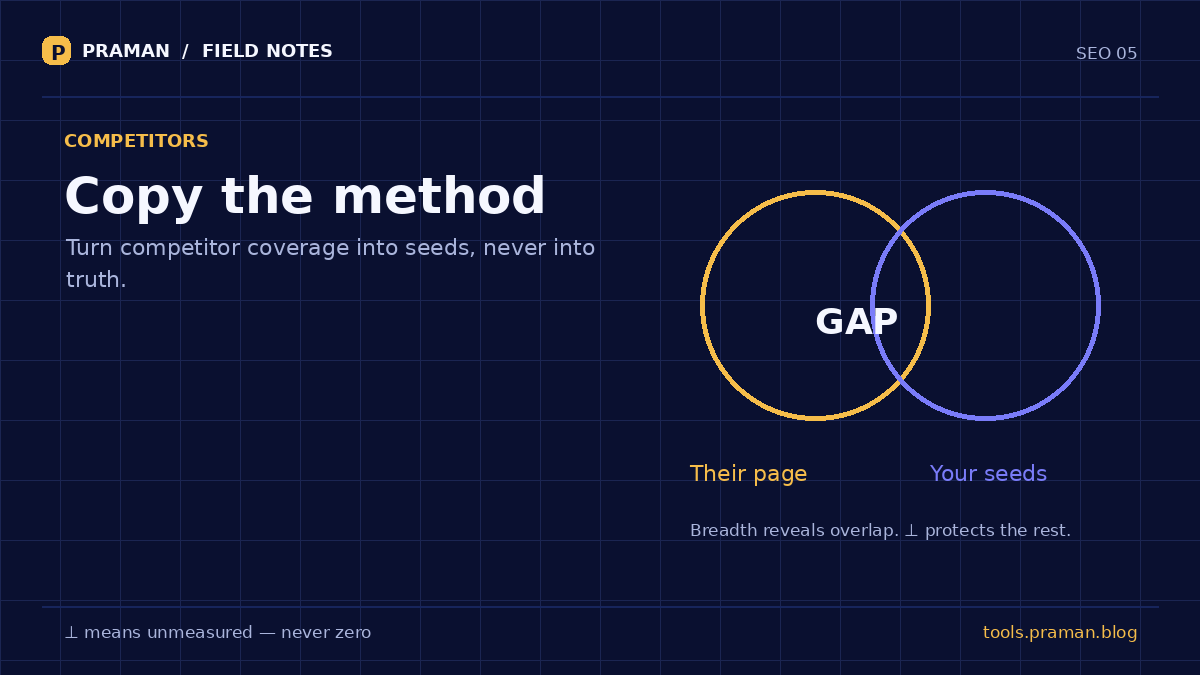
A competitor dashboard is a lovely thing right up to the moment you ask where one of its numbers came from. Rivals’ “top keywords”, estimated traffic and opportunity scores arrive pre-sorted, with an implicit instruction to reproduce them. That is dashboard worship: treating a vendor’s attribution of a competitor’s coverage as a specification for your own site. The better move is to copy the method, not the dashboard. Take what competitors actually publish — page titles, headings, visible anchors — as seed candidates, probe those seeds against public Google autocomplete, and keep your own observations attached to every row. You end up with a gap list you can defend instead of a wish list you inherited.
Key takeaways
- Competitor coverage is a seed source, not a verdict. A rival’s page tells you what they chose to publish, not what a searcher typed.
- Probe first, label second. Let observed autocomplete variants decide which gaps are worth a brief.
- Demand is a deterministic 0–1 score built from four pinned voices: breadth 50%, coverage 25%, density 15%, depth 10%.
- ⊥ is a first-class result. An unmeasured signal stays unmeasured; it never becomes zero and is never silently renormalised.
- Provenance travels with the row: seed, variant, rank, voices, mode and timestamp, in every export.
What competitor tools can and cannot see
Most competitor tools combine crawl data with modelled estimates. The crawl part is useful: it can show you that a rival maintains a page about a topic. The estimate part is a model of traffic, keyword attribution and difficulty, and its inputs are not yours to audit. Praman does not try to reverse-engineer a rival’s traffic. It measures observed public Google autocomplete signals server-side, with no API key needed from the user, and scores demand on the 0–1 scale. Those two things are different kinds of evidence and should be kept in different columns.
| Question | Dashboard answer | Observable answer |
|---|---|---|
| Does a rival cover a topic? | Top-keyword list, estimated clicks | Yes or no, from the published page itself |
| Do people phrase it that way? | Borrowed volume and difficulty | Variant strings and ranks from a live autocomplete probe |
| Is the topic worth a page? | Opportunity score | Your 0–1 demand score plus your own site’s coverage |
| What was not measured? | Usually blank or zero | ⊥, carried explicitly |
None of this makes competitor research less valuable. It makes it honest about what each column means. For the wider argument against treating estimates as observations, see why keyword volume is a guess.
Turning competitor pages into seeds
Seeds should come from language, not from a vendor’s taxonomy. Open a handful of rival pages and extract the title, H2s, FAQ questions and internal anchor text. Strip brand names and product names that only describe the rival. What remains are candidate phrases a searcher might plausibly use. Probe those phrases one at a time and record what autocomplete actually emits.
In a live Praman autocomplete probe in India (November 2026), the seed competitor keyword research produced competitor keyword research tool at rank 1, competitor keyword research tool free at rank 2, competitive keyword research at rank 3, how to do competitor keyword research at rank 6, seo keyword research and competitor analysis at rank 9 and competitor keyword research best practices at rank 17. That is one seed cluster’s observations. It is not evidence of broad cross-seed consensus, and it says nothing about monthly searches.
- Collect five to ten rival pages on the topic, not just the highest-ranking one.
- Extract visible phrases; discard anything that is purely a brand or a slogan.
- Probe each phrase in Live mode and keep the returned variants and ranks.
- Mark each variant against your own site: covered, thin, absent, or ⊥ if you never checked.
A gap matrix
The matrix is where competitor work becomes a decision. Keep the observed string and its rank next to the editorial call, so nobody later mistakes the call for the observation.
| Cluster | Rival coverage | Our coverage | Observed variant and rank | Call |
|---|---|---|---|---|
| Tool selection | Guide page | Absent | competitor keyword research tool, rank 1 | Build |
| Free tools | Pricing mention | Absent | competitor keyword research tool free, rank 2 | Build, with constraints stated |
| Process | Long how-to | Thin note | how to do competitor keyword research, rank 6 | Expand or differentiate |
| Combined framing | Services page | Absent | seo keyword research and competitor analysis, rank 9 | Test as a section, not a site |
| Best practices | Checklist page | Similar page | competitor keyword research best practices, rank 17 | Leave alone for now |
“Leave alone” is a legitimate outcome. Gap analysis is not a mandate to publish everything a competitor has.
Reading breadth honestly
Demand in Praman is scored on a deterministic 0–1 scale from four pinned voices: breadth 50%, coverage 25%, density 15% and depth 10%. Breadth asks how many of your seeds produced the variant. That matters here because a string observed under one rival-themed seed is weaker evidence than the same string appearing across several independent seeds. If you ran a single-seed probe, say so. Do not describe one observation as breadth.
Coverage, density and depth add different information: how much of the suggestion set you captured, how tightly related variants cluster around a seed, and how far a variant sits down an autocomplete chain. A rank-1 string in one probe can still be a narrow signal. A rank-17 string repeated across several seeds may be the safer content bet. The score ranks evidence; it does not tell you what to write. The weights are fixed, so you cannot quietly tune the model until your preferred gap wins.
A competitor’s keyword list is a hypothesis about their page. Your probe is evidence about language. Never promote one into the other.
Where ⊥ matters most
Gap analysis produces more unmeasured states than most workflows. You probably did not probe every locale, script or device context a rival might be targeting. You may not have checked whether a variant appears under an adjacent seed. Those signals stay ⊥ — never zero, never silently renormalised into the average. A blank cell in a spreadsheet is not the same as a measured absence, and a rival’s page does not convert ⊥ into a number.
Mode discipline keeps the distinction visible. Live mode is real observed autocomplete. Demo mode is free but always labelled sample data, useful for learning the interface and never for a content decision. Replay uses recorded JSON, so a colleague can inspect exactly the probe you ran. Runs are saved and exportable as Markdown, CSV, JSON and HTML, with seed, variant, rank, voices, mode and timestamp on every row. The hosted app at tools.praman.blog/app is a separate product from the downloadable ZIP; do not mix their results in one report.
From gap to brief
Hand the writer evidence, not a verdict. A useful brief names the seed, the observed variants and ranks, the score on the 0–1 scale, the four voices, the mode, and the timestamp. It states what is covered already and which signals are ⊥. Then it asks a question the evidence cannot answer: what can we say that the rival page does not?
- Name one primary seed and list the observed variants verbatim.
- Attach ranks and mode to each variant; never strip provenance during copy-and-paste.
- Write the coverage decision: build, expand, differentiate or leave alone.
- List explicit ⊥ signals so the writer knows where not to claim certainty.
- Choose an export format that survives handoff: JSON for tooling, CSV for analysis, Markdown for editing, HTML for sharing.
The method behind the scoring is written out at the methodology page. If you want the full seed-to-decision sequence, start with the pillar guide. Evidence hygiene is covered in keyword research shows its work.
FAQ
Does this replace a competitor traffic tool?
No. It replaces the habit of copying a competitor’s keyword list uncritically. Use a traffic tool if you need modelled estimates, but keep them in a separate column from observed autocomplete evidence and your own 0–1 scores.
How many competitor seeds should I probe?
Enough to test breadth. Five to ten phrase seeds from different page types is a reasonable start. One seed can reveal phrasing; several seeds tell you whether that phrasing recurs.
What if a rival covers a topic we cannot measure in our locale?
Mark the unmeasured signals ⊥ and say why. Do not score them zero, and do not borrow the rival’s numbers to fill the gap. A defensible blank beats an invented value.
Web desk
YouTube desk
Run the method on one seed.
Open the workspace, start with a free labelled demo, then switch to Live when you want observed autocomplete with provenance attached to every row and export.
Demo runs are free and labelled. Live and Replay share one run pool across all three desks.
Leave a Reply