
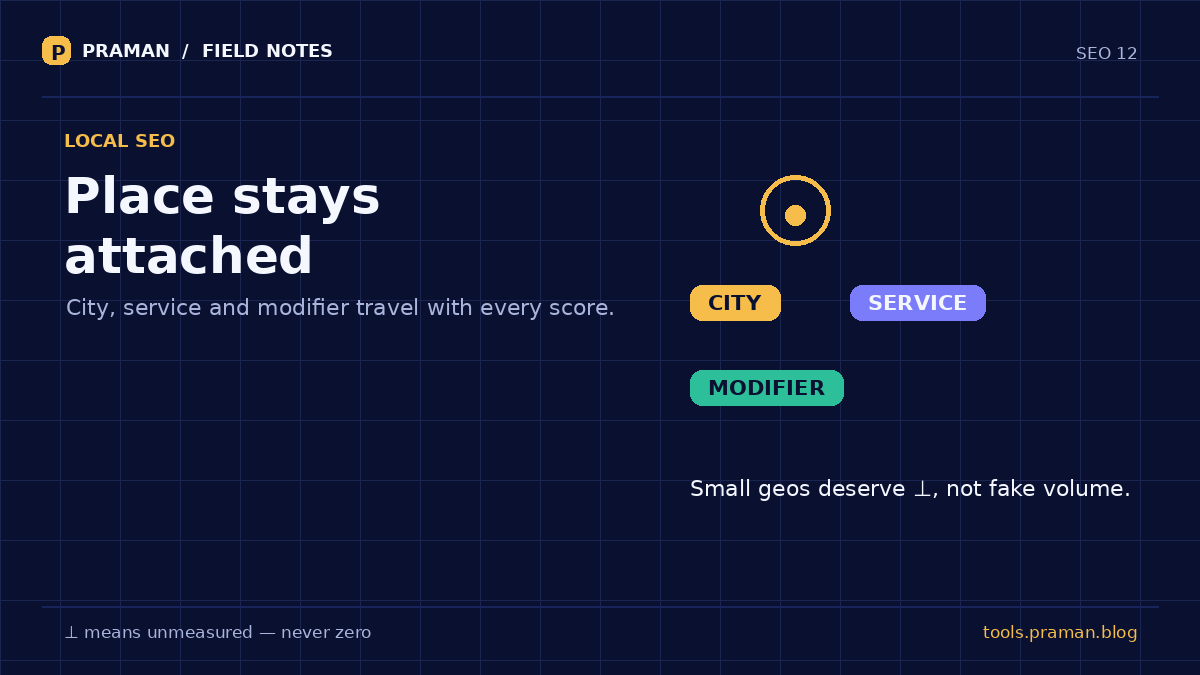
Local SEO attracts a particular kind of bad number: a monthly count for “dentist” that quietly pretends a national total tells you anything about a clinic in Pune. A local query carries three things at once — a service, a place and a situation — and none of them survives being averaged into a single volume column. The way out is not a better estimate. It is a different object of study: observed autocomplete strings, each attached to the seed that produced it and the place you probed from.
Key takeaways
- Local is a place dimension on a query, not a separate fantasy volume model.
- Build seeds from city, service and modifier, and probe each shape separately.
- Demand is a deterministic 0–1 score from observed signals, never a claim about monthly searches.
- Four pinned voices — breadth 50%, coverage 25%, density 15%, depth 10% — decide which variants rise.
- Unmeasured geos stay ⊥: never zero, never silently renormalised into the average.
- Every row keeps its seed, variant, rank, voices, mode and timestamp, and runs export to Markdown, CSV, JSON and HTML.
Why local volume is especially shaky
A national volume figure is an aggregate. Ask it a local question and it becomes an aggregate of aggregates: every town, every dialect, every searcher who happened to be nearby that week. The narrower the place, the less the original number means, yet local reporting often presents the same figure with a city name attached. That is not measurement; it is decoration.
Autocomplete has different limits. It emits language that Google has seen often enough to predict, in the locale and script you probe from. It does not emit counts, conversion rates or a promise that the phrase will rank your page. That is enough to plan a service-area architecture, provided you keep the observation honest. Our companion piece on why keyword volume is a guess covers the general failure; local simply fails faster because place is part of the query.
Praman scores demand on a deterministic 0–1 scale from those observed signals. It never invents monthly volume. A score is a ranked judgement about evidence strength, not a forecast of how many people will search in a given pin code next month.
Seed shapes for place-based demand
Do not start with one grand seed. Start with a small set of shapes, because each shape exposes a different slice of language. The strings below are seed patterns to run, not claimed observations.
| Seed shape | Example seed to probe | What you are testing |
|---|---|---|
| Place + service | dentist pune | Whether the city qualifies the service at all |
| Service + place | dentist in pune | Preposition and word-order variants |
| Neighbourhood + service | dentist baner | Whether the micro-place has its own language |
| Service + urgency | dentist near me open now | Situational modifiers, not just geography |
| Service + cost | dentist pune price | Commercial language a page must answer |
| Problem, not service | toothache pune | Entry points that never name your category |
Keep the place constant when you compare services, and keep the service constant when you compare places. Mixing both in one run produces a list you cannot read. If you work across scripts, keep Devanagari, romanised and mixed-script seeds in separate lanes rather than folding them together.
Worked city probe
Here is an observed example from a live Praman autocomplete probe on the seed local seo keywords, run in India in November 2026. These are observed variant strings and ranks — not volumes, and not a sample of any particular city’s searchers.
| Observed variant | Rank | Seed | What it tells you |
|---|---|---|---|
| local seo keyword research | 1 | local seo keywords | Research method is the strongest nearby language |
| local seo keyword research free tools | 2 | local seo keywords | A tool-seeking modifier sits close to the head |
| how to find local seo keywords | 5 | local seo keywords | A how-to frame, distinct from a tool frame |
| local seo keywords list | 7 | local seo keywords | A list-seeking frame worth a checklist page |
Notice what this run does and does not establish. It establishes that people predicting the phrase local seo keywords also complete it with method, tool and list language. It does not establish demand for a dental practice in Pune; that needs its own seeds. The discipline is to run the city + service shapes above as separate probes and compare their variant sets, rather than promoting strings from a generic run into a local plan.
Across those runs, the four voices stay pinned: breadth 50%, coverage 25%, density 15% and depth 10%. A modifier that appears under several city seeds gains breadth; a run that returns many ranked variants gains density. You are reading the shape of the evidence, not a single lucky rank.
Keeping place provenance
A variant without a seed is a rumour. A variant without a place is worse: it can be quoted back at you as if it applied everywhere. Praman carries provenance with every row — seed, variant, rank, voices, mode and timestamp — so a later reader can tell whether keywords list came from a city probe, a generic probe or a sample run.
Modes matter as much as ranks. Live means real observed autocomplete at the time of the probe. Demo is free, useful for learning the interface, and always labelled sample data — never evidence about a market. Replay reads recorded JSON so a decision can be checked against the same inputs later. If a column in your report does not say which mode produced it, the report is not auditable. This is the standard argued in keyword research should show its work.
Runs are saved and exportable as Markdown, CSV, JSON and HTML. For local work, the CSV or JSON is usually the important one: it lets a place column survive into the content brief instead of being dropped when someone pastes keywords into a doc. See from spreadsheet to decision export format for the handoff.
The ⊥ boundary in small geos
Small towns, narrow services and script-specific phrasing often return little or nothing from a probe. The honest result is ⊥: unmeasured. Not 0, not “no demand”, and not a value quietly renormalised so the dashboard looks complete. ⊥ is first-class because absence of observation is not observation of absence.
Practically, ⊥ is a prompt to change the probe: try the neighbouring city, the romanised form, a broader service phrase or a problem seed. If it stays ⊥ after reasonable attempts, the correct output is a documented gap, not a page justified by a zero. Read unmeasured vs zero if you need the argument in full.
A local keyword without its place attached is not a keyword you can act on; it is a keyword you have mislaid.
From list to local page
Turn rows into pages only when the evidence supports a distinction. A short checklist keeps the work defensible:
- Does the variant name a place? If not, it belongs on a generic service page.
- Does it name a service, a problem or a commercial modifier? Match the page type to the language.
- Do two place variants share the same modifier set? One template may serve both; duplicate pages need not.
- Is any relevant cell ⊥? Record it as a gap rather than filling it with a guessed number.
- Can you name the seed, rank, mode and timestamp behind each heading on the page?
That last question is the one that survives an audit. A local page built from traceable variants can be edited when the probes change; a local page built from an invented monthly count cannot.
FAQ
Does autocomplete give me local search volume?
No. It gives observed query completions in the locale and script you probe. Praman turns those signals into a deterministic 0–1 demand score and keeps the source strings visible. It never converts them into monthly searches.
Should I run a separate probe for every city?
Only for cities you intend to serve with distinct pages or campaigns. Start with the places that matter commercially, keep each probe’s place attached in the export, and mark the rest ⊥ rather than guessing.
If two neighbourhoods share every variant, do I need two pages?
Shared variant sets are evidence against splitting. Keep one page unless you have observed language that genuinely differentiates the neighbourhoods, or a separate operational reason to divide them.
Web desk
YouTube desk
Run the method on one seed.
Open the workspace, start with a free labelled demo, then switch to Live when you want observed autocomplete with provenance attached to every row and export.
Demo runs are free and labelled. Live and Replay share one run pool across all three desks.
Leave a Reply