
The last ten minutes of a research project decide whether the first ten hours matter. You can run a careful batch of seeds, read every suggestion, and still lose the work at the handoff — the moment the result has to leave your account and become a brief, a sheet, or a decision someone signs off on.
That moment is where much keyword tooling quietly fails. The dashboard is polished; the explanation is a screenshot. An export format is not a plumbing detail. It is the shape the evidence takes when nobody is watching the app.
Key takeaways
- Treat the export as part of the method, not a file type attached at the end.
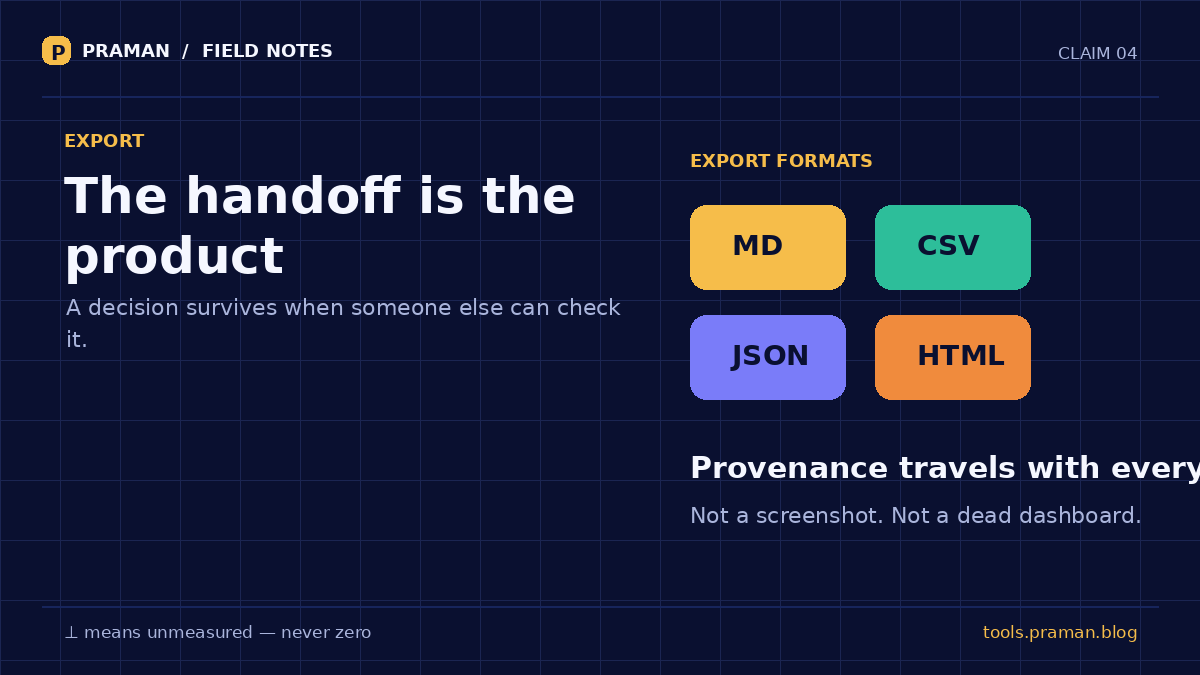
- Praman writes Markdown, CSV, JSON and HTML from one saved run, so the formats agree with each other.
- Every row keeps its demand score, its four pinned voices and its mode label.
- Unmeasured probes stay ⊥ in the file. They must never become empty cells that a spreadsheet reads as zero.
- Saved JSON is what makes an old decision reproducible, not merely documented.
Why the handoff breaks
A dashboard does not travel
Charts live inside a product account. In the meeting, someone copies a column into a deck. Six weeks later, nobody can say whether a keyword was measured, inferred, or typed in by hand. The number survived; the reason did not. You cannot challenge a figure you can no longer open.
A screenshot is not evidence
Screenshots are fine for a walkthrough and poor for a decision. They crop out the run date, the mode and the probes that failed. They also make it easy to put an illustrative Demo screen next to a Live result and forget the difference. Once provenance is gone, the number asks to be trusted on faith.
Flat tables change the meaning
A minimal CSV keeps the keyword and the final score, then drops everything that explains the score. The four voices vanish. ⊥ becomes a blank cell that a spreadsheet reads as zero. The handoff looks tidy, and it has quietly changed what the research said.
Export as part of the method
Praman generates all four formats from the same saved run. That matters more than the list of formats: there is no moment where someone retypes figures into another system and creates a second version of the truth. The scale behind the score is a deterministic 0–1 demand score built on observed public autocomplete signals, with the weights printed alongside it — breadth 50%, coverage 25%, density 15%, depth 10%.
Four formats, four jobs
- Markdown for a readable brief in a repo or notes app, with tables and the content calendar intact.
- CSV for sheets and further sorting, with the keyword metrics ready to filter.
- JSON for automation or for attaching a run to your own pipeline.
- HTML for a client-ready report that makes sense with the app closed.
Provenance is a field, not a footnote
Mode labels stay attached to the data: DEMO · SYNTHETIC FIXTURES, LIVE · GOOGLE AUTOCOMPLETE · RESULTS VARY, or REPLAY · RECORDED JSON. Demo is sample data, useful for learning the workflow and never for claiming a market observation. Live calls Google public autocomplete server-side, and no API key is required. Replay restores recorded inputs.
⊥ survives the spreadsheet
Measured absence is 0.0. A probe that timed out or was never reached is ⊥, and it stays ⊥ in the export. The weights do not renormalise around the gap. That single distinction is why a run made on a bad connection can still be compared with an earlier run.
A handoff that survives a hard question
Imagine a reviewer asking why a Marathi topic was prioritised over an English one. Rather than argue from memory, you open the CSV and show breadth and question density for each seed. You point to the mode label and the run date. Then you load the saved JSON and reproduce the same score from the same inputs. The discussion is now about evidence, not taste.
A handoff succeeds when the person receiving it can disagree with you precisely.
What an export cannot add
No format manufactures facts that were not measured. Exports do not supply exact search volume, clicks, or private competitor data. An HTML report is only as honest as the run behind it, so keep the mode label visible and never present synthetic Demo fixtures as live observations. The methodology is the place to check what each voice actually means before you forward a report.
What to do next
Open the hosted app and run five seeds in Demo. Export that same run as CSV and HTML, then check that the four voices, the mode label and any ⊥ values survived both formats. Keep the JSON if you want a record for future review. When you are ready for real observations, switch to Live; plans are listed separately.
Leave a Reply